

Last September, Steny Gladson from Coimbatore had his first hero product doing ₹4.2 lakh a month on Amazon India. Six weeks later, he’d launched his second product. Both slid down the rankings at the same time. His cash was split, his PPC was split, his attention was split, and neither SKU had enough of him to keep moving.
Deciding when to launch your second Amazon product is one of the most misread moments in a private-label journey. Most sellers treat it like a milestone to chase. The ones who build real brands treat it like a decision to earn. Get the timing right and your second product compounds your first. Get it wrong and you turn a healthy business into two struggling ones. This post walks you through the green-light signals, the red-light traps, and the honest timing rules most guides skip.
Why Most Sellers Get the Second Product Wrong

Orders are consistent, confidence is rising, you start thinking about what’s next. This is where the trap opens.
The trap of “I’m bored, let me launch something new”
Most second launches are driven by seller restlessness, not readiness. The first product stops feeling exciting, and you start scrolling Helium 10 looking for the next winner. That itch feels like ambition, but it’s impatience wearing a suit. Vikram’s first product was stable and growing. He wasn’t short on cash, he was short on excitement. So he chased a new category, split his PPC budget, and watched both products drop out of their honeymoon windows together.
Why launch timing matters more than product choice
The second product inherits everything your first has built or broken: cash reserves, PPC experience, supplier trust, bandwidth. A great product launched at the wrong time becomes a drag. The right amazon product launch timing compounds quietly for years. Anjali Verma from Jaipur waited six extra months before launching her second skincare SKU. Her launch broke even in 11 weeks. A friend who rushed the same idea spent nine months keeping both products alive. That’s why a proper 14-day launch plan that builds organic rank matters more than the launch date itself.
The 5 Green-Light Signals You’re Ready to Launch
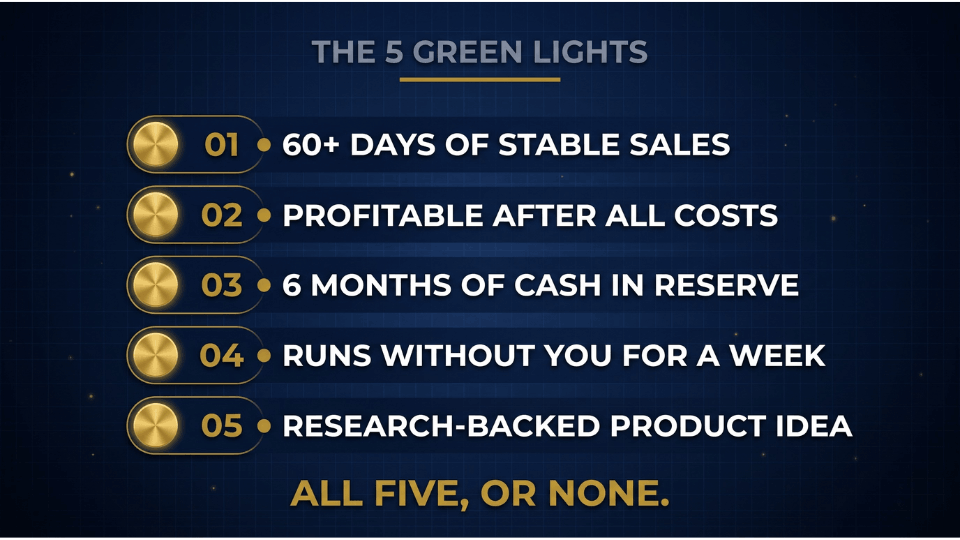
The honest answer isn’t on a calendar. It’s in five signals that tell you whether your business can carry a second SKU without breaking.
Signal 1 – Your first product has 60+ days of stable sales velocity
Amazon’s honeymoon period distorts everything. Your first 30 to 45 days look artificially good because the algorithm gives you a visibility boost. Wait until you have 60 days of post-honeymoon stability, where daily sales move within a narrow band. Priya Sharma from Pune waited until her daily units settled at 22 to 28 for two straight months before she started second-product research.
Signal 2 – Your product is profitable after all costs
Not profitable on paper. Profitable after referral fees, FBA fees, storage, PPC, and returns. If your net margin sits under 15 percent, a second product will drown your cash before it scales. A product sold at ₹499 should leave you at least ₹75 after every cost.
Signal 3 – You have six months of operating cash in reserve
Launching a second amazon fba product costs roughly three times your monthly sales in inventory alone, before photography, packaging, and PPC runway. India’s GST cycle and Amazon’s payout cycle can squeeze cash the month you’re most stretched. Six months isn’t a cushion — it’s the minimum survival buffer.
Signal 4 – Your first product runs without you for a full week
Can you travel for a week, stay off Seller Central, and come back to a healthy account? If not, you have a job, not a business. Running without you means documented processes for PPC, replenishment, and customer messages. Without that layer, a second product doubles the daily chaos.
Signal 5 – You have a research-backed second product idea
A real candidate has validated search volume over 12 months, review gaps in the top 10 competing listings, a believable category demand curve, and a physical sample in your hand. Jebith Rajesh from Bangalore spent three months on this before a single unit was manufactured. Anything less than that level of preparation is gambling — the same discipline you’d use to select a winning Amazon product in a saturated market applies to signs to launch next amazon product too.
Before you spend another rupee on sampling, run your business through these five signals honestly. Our Second Product Readiness Checklist gives you the same framework as a worksheet with scoring and space for your real numbers.
The 4 Red-Light Anti-Signals That Mean You Should Wait
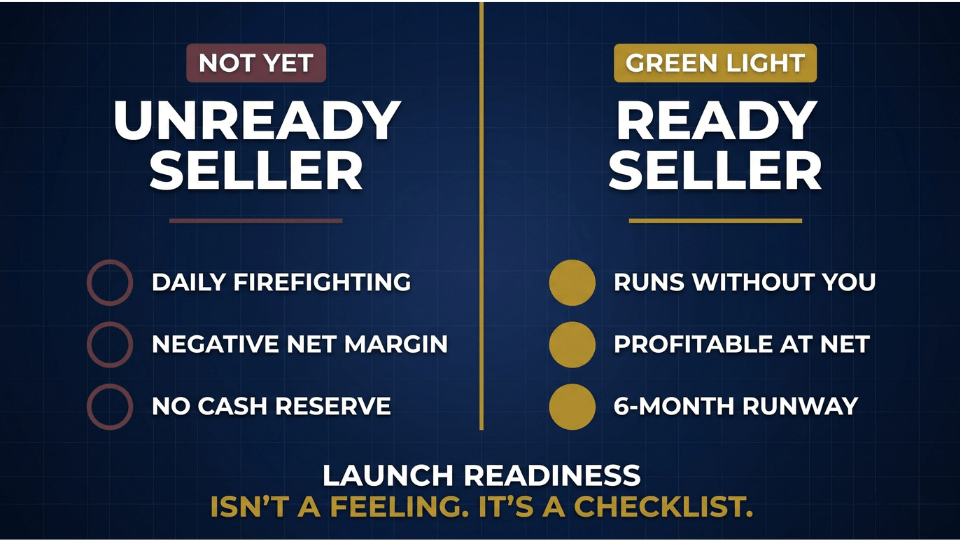
Green lights tell you when to move. Red lights tell you when to stop. These are the ones most sellers miss because they feel counterintuitive when a new idea feels exciting.
Anti-signal 1 – Your first product still needs daily firefighting
Stockouts every few weeks, listing suppressions you’re still appealing, ACoS climbing faster than sales. If your first product demands you every day, a second one won’t add revenue, it will break both. Sneha Rao from Hyderabad launched SKU two while still fighting a hijacker on SKU one. Within a month, both listings had suppressed variations.
Anti-signal 2 – You’re launching to solve a revenue problem
Your first product isn’t selling enough, so you think a second will rescue the numbers. It won’t. Two underperforming products compete for the same thin cash and attention. The better move is uncomfortable: fix your first product, or honestly kill it and replace it. An amazon private label second product launched from desperation almost always ends badly.
Anti-signal 3 – You haven’t broken even on product one
If you haven’t recovered your initial investment, launching a second product means you’re using future revenue as an interest-free loan. If you invested ₹3 lakh and only seen ₹1.4 lakh come back, you don’t have a profit, you have a hope. Compounding that hope is how cash flow crises start.
Anti-signal 4 – You’re chasing a trend, not a category
Trends die faster than your inventory cycle. A two-year Google Trends line that looks like a mountain peak is a warning, not an opportunity. A steady, boring upward slope across a full category is what you want. If you spot these early signs you picked the wrong Amazon product in your first SKU, fix that before even thinking about a second.
How Long Should You Really Wait Between Launches?
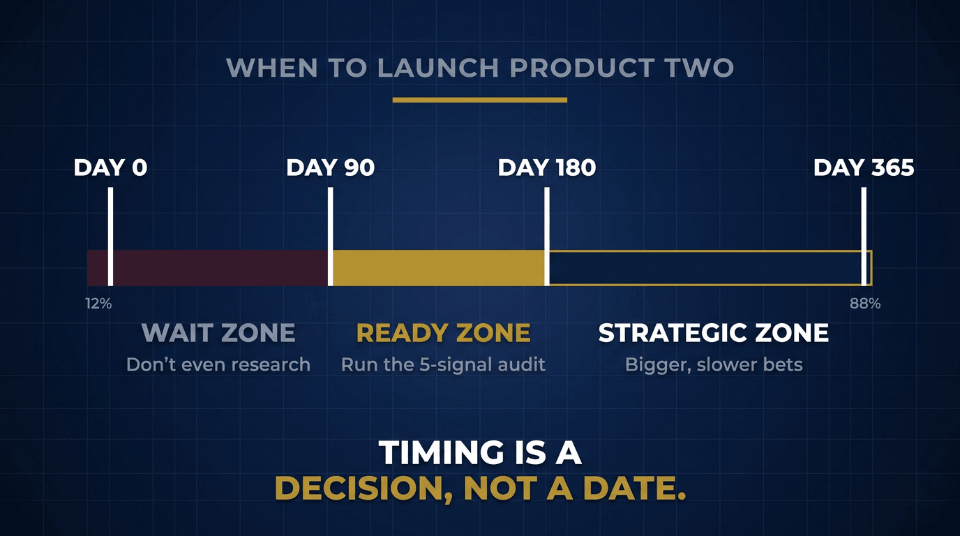
The internet loves a clean number. The honest answer is that it depends on readiness, not the calendar.
The 90 to 180 day rule
For most private-label sellers, 90 days is the minimum. That’s how long your first product needs to clear the honeymoon and generate real data. 180 days is safer if cash is tight or operations are still manual. Sellers who launch before 90 days rarely have enough baseline data to know whether their first product is healthy.
When faster launches make sense
Not every “second product” is a true new launch. A size variation, colour variation, or bundle shares the supplier, photography, audience, and often the reviews. The risk profile is entirely different. You can move faster on variations because the expansion leverages work you’ve already done.
When you should wait longer than 180 days
High-capital products, regulated categories like BIS-certified electronics or FSSAI-controlled food, and seasonal products all demand longer runways. Meera Pillai from Kochi waited 11 months because her product needed BIS certification and her first was seasonal. Her launch hit in peak season with clean paperwork. That’s the version of second product launch checklist thinking that separates brands from sellers.
Should Your Second Product Be in the Same Category?
Your category decision shapes your brand, your cash efficiency, and your long-term exit value.
The case for staying in the same category
Staying gives you compounding advantages: shared audience, shared keywords, shared supplier ecosystem, shared photography style. You can use Amazon Posts, Brand Story, and Brand Analytics to amplify both products. Your customers start recognising you as a brand instead of a random seller. This is how you expand amazon product catalog into real brand equity instead of just adding SKUs.
The case for a different category
Diversifying de-risks you against category shocks: fee changes, regulatory shifts, demand drops. But this kind of amazon product line expansion only works if your first product’s operations are systemised. If you’re still answering buyer messages at night, a new category just doubles your night shift.
The brand universe test
Would a customer who bought your first product plausibly buy your second? If yes, you’re expanding a brand. If no, you’re starting a second business and calling it expansion. A skincare seller adding lip care is one brand. A skincare seller adding kitchen tools is two businesses wearing the same storefront. When you add second product to amazon store, the brand universe test is the cheapest gut-check you can run.
How Many Products Should an Amazon Seller Actually Have?
The number itself matters less than what it tells you about your strategy. Most sellers overestimate how many SKUs they need.
What the data actually shows
For most private-label sellers, 5 to 15 SKUs in the first two years is healthy. Globally, around a quarter of Amazon sellers run just one product, and many are more profitable per hour than sellers with 20 SKUs. Margins tend to peak between 10 and 18 products before operational complexity eats the gains. Our ₹10 lakh Amazon business blueprint breaks down the month-by-month milestones most sellers use to decide when to expand.
Why more SKUs doesn’t mean more profit
Catalog bloat is the quiet killer. Unprofitable SKUs hide inside healthy-looking top-line revenue. Every new SKU adds PPC campaigns to manage, reviews to chase, returns to process, and supplier follow-ups. Kavya Menon from Chennai had 12 SKUs and lower take-home profit than when she had 4. She cut six, kept the top four, and her profit went up while her work went down. That is amazon seller catalog expansion strategy working in reverse, and it’s often the right move.
If you’re ready to research properly before your next launch, our product-selection swipe file gives you the exact spreadsheet columns, scoring system, and validation criteria that separate hunches from data.
The Pre-Launch Checklist Before You Order Inventory
Scaling amazon fba with second product capital demands a disciplined check across three areas before the wire transfer.
- Operations readiness — Documented SOPs for PPC, reviews, and replenishment on product one. A virtual assistant or team member handling daily tasks. Clean Seller Central account health with AHR above 200.
- Financial readiness — First product has crossed break-even. Six months of operating cash confirmed in the bank, not projected. Tax-adjusted margin modelled for the new SKU including GST and TDS. PPC launch budget earmarked separately from product-one spend.
- Product-fit readiness — Keyword demand validated over a 12-month window. Top 10 competing listings analysed for review gaps and pricing. Sample physically in your hand, tested across multiple users, photographed in real conditions.
The trap is treating this as a tick-box exercise. Each item has to be genuinely true, not almost-true. “Nearly broken even” is not broken even. Honest grading now prevents expensive damage later.
What to Do Right Now, Depending on Where You Are
The right next action depends on where your first product is in its life.
If your first product is under 60 days old
Don’t think about product two yet. Stabilise PPC, push for your first 30 reviews, and lock in reorder timing. Follow a clear framework like your first 30 days of Amazon PPC so the foundation is sound. Any attention spent on product two now is stolen from the launch that matters most.
If you’re 60 to 180 days in and the numbers are good
You’re in research mode, not ordering mode. Build a shortlist of five candidate products, validate each over a 30-day window, and talk to three suppliers before you pick. Don’t commit inventory capital until you have 60 days of stable velocity on product one.
If you’re past 180 days with a profitable first product
You’re genuinely in the decision zone. Run the five-signal self-audit this week. If all five lights are green and none of the four red flags apply, move forward. If even one red flag is true, fix that first and revisit in 30 days.
Knowing when to launch second amazon product is only the beginning. The harder work is building the systems, cash reserves, and decision frameworks that make each launch easier than the last.
FAQ
When should I launch my second product on Amazon?
Launch only after your first product has at least 60 days of stable post-honeymoon sales, genuine profitability after all costs, six months of operating cash, documented operations that don’t need your daily attention, and a research-backed idea with a sample in hand. If even one is missing, wait.
How many products should an Amazon FBA seller have?
For most private-label sellers in the first two years, 5 to 15 SKUs is a healthy range. Margins tend to peak between 10 and 18 products before complexity eats the gains. Around a quarter of Amazon sellers globally run just one product, and many are more profitable per hour than sellers with large catalogs.
How long should I wait before launching another product on Amazon?
Ninety days is the realistic minimum, because that’s how long your first product needs to clear the honeymoon and produce reliable baseline data. 180 days is safer if cash is tight. Regulated and seasonal products need longer runways.
What are the signs I’m ready to scale with a new product?
Five signals: 60 or more days of stable velocity on product one, genuine profitability after every cost including PPC and returns, six months of operating cash in reserve, a business that runs a full week without you, and a second product idea backed by data and a physical sample.
Should my second Amazon product be in the same category as my first?
Usually yes. Same category gives you shared audience, keywords, suppliers, and photography. Use the brand universe test: would a customer who bought product one plausibly buy product two? If yes, you’re expanding a brand. If no, you’re starting a second business.
Can I launch a second product while my first is still losing money?
No. Launching from a loss-making first product splits thin cash and attention across two drowning SKUs. Fix the first product’s margin, pricing, or positioning first. If it can’t be fixed, kill it and replace it.
How much money do I need in reserve before launching a second product?
Six months of operating expenses, confirmed in the bank rather than projected. The launch itself typically needs three times your monthly sales in inventory alone, before packaging, photography, and PPC. Treat six months as the floor.
Is it better to launch a variation or a new product as my second SKU?
For most sellers, a variation or bundle is the smarter first move. Variations share the supplier, photography, audience, and often the reviews of your existing product, so the risk profile is much lower. A standalone new product is the right call only once operations are systemised.
Conclusion
Your second product isn’t a milestone to chase. It’s a decision to earn. Most sellers treat launch number two as the finish line of phase one, when it’s the start of a harder test: whether your business can support compounding instead of just surviving. Get the timing right and your second SKU quietly multiplies your first. Get it wrong and you turn one healthy business into two struggling ones.
If you want the exact decision framework, cash flow model, and launch sequencing used by sellers who scaled from one product into a real brand, our 3-Day Amazon Business Training walks through it step by step. Your second product won’t make you a bigger seller. It will reveal whether you’ve built the kind of business that deserves one.
