
Last November, Deepak Nair from Kochi launched a stainless steel lunch box on Amazon India. He had ₹60,000 set aside for ads but no structured plan for the first two weeks. He threw money into auto campaigns, let them run without adjustments, and waited. By day 14, his organic rank hadn't budged past page four.
Here is what Deepak didn't realise: Amazon's algorithm evaluates new listings most aggressively during the first 15 to 30 days. Most guides hand you a 90-day plan, but the first 14 days are where your Amazon product launch plan either builds momentum or stalls out. This article gives you a day-by-day framework designed for Indian sellers who want to build real organic rank — not just burn through PPC budgets hoping something sticks.
Why the First 14 Days Define Your Amazon Organic Ranking
What Amazon's Algorithm Watches During the Honeymoon Period
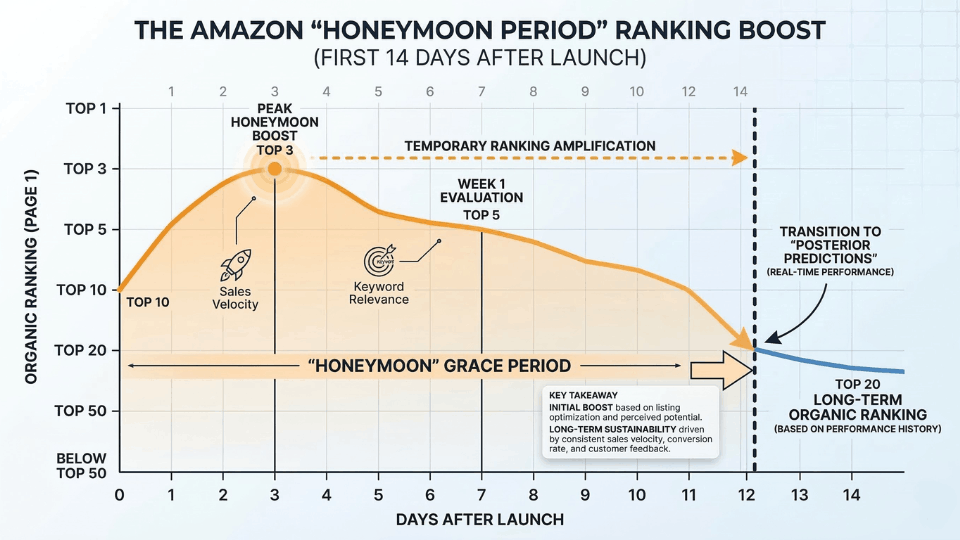
When you list a new product, Amazon's A10 algorithm gives it a brief window of elevated visibility — sellers call this the honeymoon period. For roughly 15 to 45 days, the algorithm tracks your click-through rate, conversion rate, sales velocity, and keyword relevance more closely than at any other time. New ASINs that generate strong early signals get pushed higher. Those that don't get buried, and climbing back from page five is far more expensive than getting it right the first time.
Why 14 Days, Not 90?
The 90-day plan is the full marathon, but the first 14 days are the sprint that sets your pace. Amazon's cold-start system relies heavily on early data because it has no sales history to compare you against. By day 14, the algorithm has gathered enough to decide whether to push your listing upward or let it slide. A focused, front-loaded launch maximises this window rather than spreading effort thin over three months.
How Indian Sellers Can Use This Window Differently
Indian marketplace dynamics create unique constraints. Access to Amazon Attribution remains limited for many Amazon.in sellers, PPC cost structures differ from US, and seasonal timing around Diwali can dramatically affect launch performance. Smaller review pools mean even five to eight early reviews can shift your conversion rate meaningfully. The 14-day plan works especially well for Indian sellers who need to be capital-efficient.
Days 1–3 of Your Amazon Product Launch Plan: Listing and PPC Foundation
Optimise Your Listing Before You Spend a Single Rupee on Ads
Your listing must convert before you drive traffic to it. Front-load your primary keyword in the title, fill all five backend search term fields without repeating words, write keyword-rich bullet points that actually convert, and ensure your A+ Content is live with lifestyle images. Meera Joshi from Ahmedabad learned this the hard way — she launched with manufacturer stock photos and a generic title. Before turning on ads, she rewrote her title and bullets, added lifestyle images showing her product in an Indian kitchen, and watched her session-to-sale rate jump from 4% to 11%.
Launch Your PPC Campaigns in the Right Structure
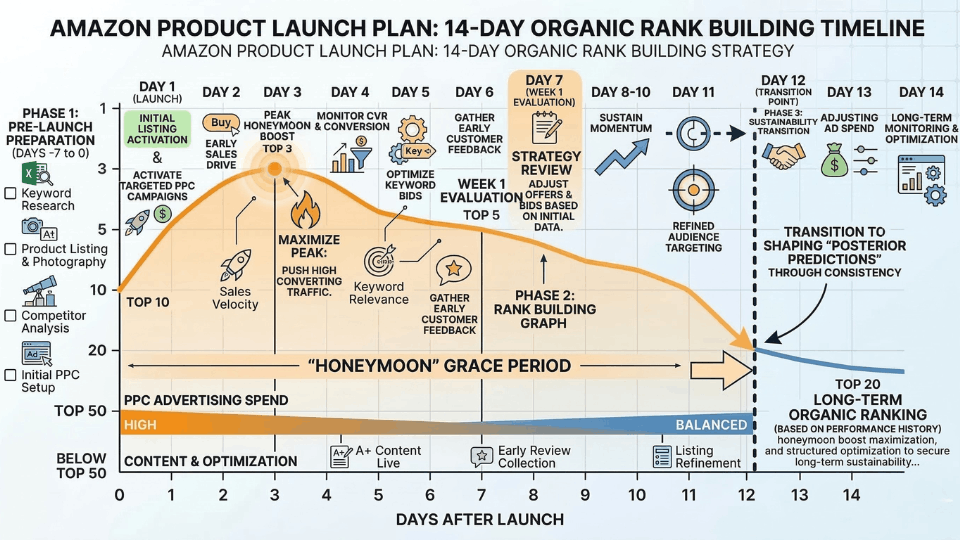
Day one is for your auto campaign — let Amazon discover relevant keywords. On day two, launch a broad match manual campaign targeting 15 to 30 keywords. By day three, set up an exact match campaign for your top five to ten high-intent keywords. Allocate roughly 70% of budget to Sponsored Products and set bids 10 to 15% above Amazon's suggestion. This is not the time to be conservative — the algorithm is watching how aggressively you compete for visibility in these early days. If you want a deeper breakdown of this exact structure, our guide on launch PPC campaigns you need walks through each step.
Days 4–7: Driving Sales Velocity and Early Keyword Ranking
Mine Your Search Term Report and Add Negative Keywords
By day four, your auto campaign has enough data to act on. Download the search term report from Seller Central. Look for keywords that received clicks but zero sales — add these as negative keywords immediately. Then find converting search terms and move them into your exact match campaign. This habit of mining and refining every few days is how you shift from spraying money broadly to focusing spend on the keywords that actually build organic rank. Our detailed guide on reading your search term report like a pro shows you exactly what to look for.
Push for Top-of-Search Placement on Priority Keywords
Increase your top-of-search bid adjustment by 50 to 100% for your five most important exact-match keywords. Amazon's algorithm gives more weight to sales generated from top-of-search placement when calculating organic rank. Arjun Reddy from Hyderabad applied this on day five for three keywords. He bumped his top-of-search modifier to 80% and by day seven, his organic rank for his primary keyword moved from page six to page two. The extra spend was significant, but the organic rank movement meant he could start reducing those bids within a week.
Use External Traffic to Signal Demand Beyond Amazon
Amazon's A10 algorithm increasingly values traffic from outside the marketplace. Share your product link on Instagram, in relevant WhatsApp groups, or through a small Google Ads campaign. Even 20 to 30 external clicks per day that convert tell the algorithm your product has demand beyond Amazon's ecosystem. Indian sellers can leverage WhatsApp broadcast lists and regional Facebook groups — low-cost channels that US-focused guides overlook entirely. For tracking these efforts on Amazon.in, our guide on external traffic tracking without Attribution covers the workarounds.
Days 8–11: Scaling What Works in Your Amazon Launch Checklist
Double Down on Winning Keywords, Cut the Losers
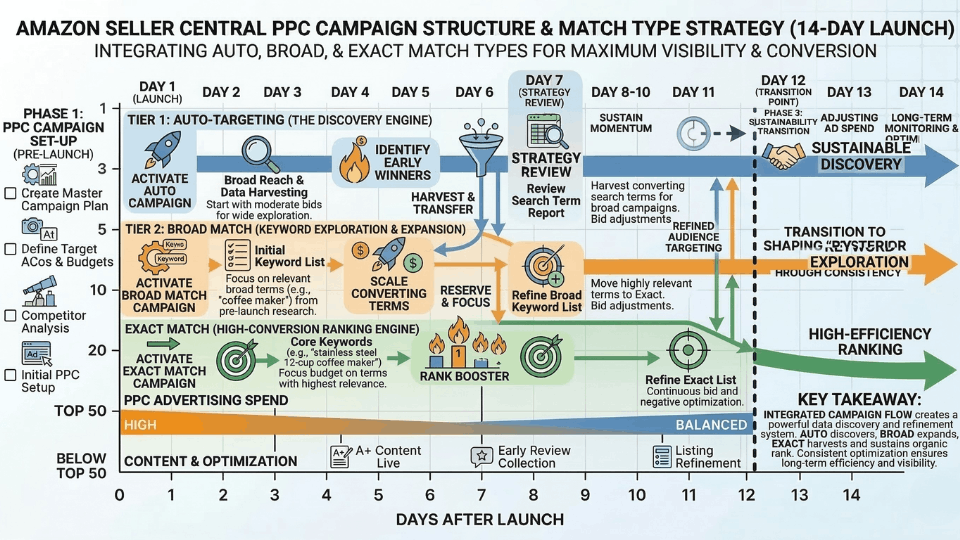
By day eight, you have a full week of PPC data. Identify keywords with conversion rates above your category average and increase bids. Pause or sharply reduce bids on keywords that consumed budget without sales. The shift is decisive — move budget from auto and broad campaigns toward winning exact-match terms. Use Helium 10 or Brand Analytics to cross-reference which ad-driven keywords are improving your organic rank.
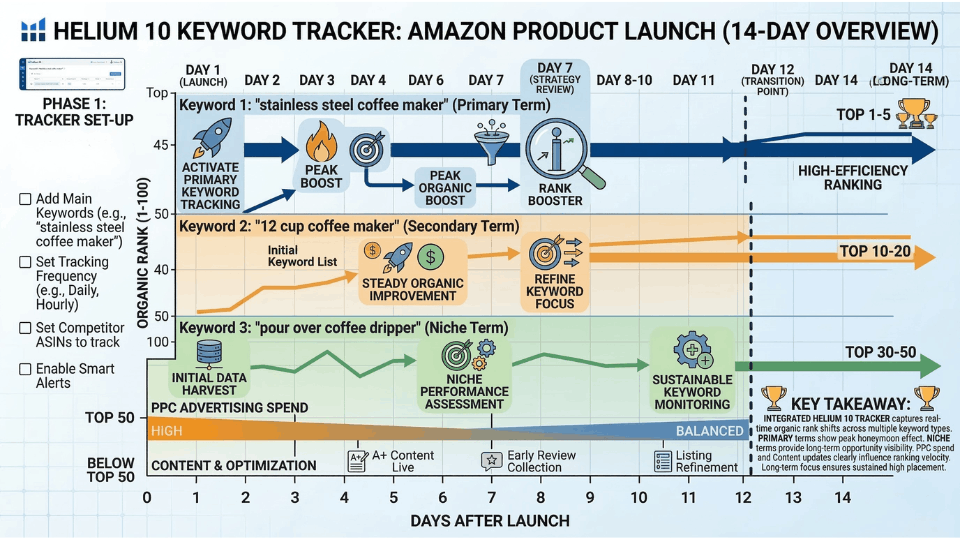
Monitor Your Organic Rank Movement Daily
Keyword tracking is non-negotiable during this phase. Check daily whether PPC-driven sales are translating into organic rank improvements. If a keyword has moved from page five to page two, keep pushing. If another hasn't moved despite decent ad sales, check whether it appears in your title or bullets. Sneha Kapoor from Delhi tracked 12 keywords daily from day eight. By day ten, five had reached page one or two organically. She shifted remaining budget to the seven lagging keywords and cracked page two on four more by day 14.
Encourage Early Reviews Without Breaking Amazon's Rules
Even five to ten honest reviews by day ten can meaningfully improve your conversion rate, which directly accelerates organic ranking. A listing with eight reviews at 4.5 stars converts far better than one at zero, and that difference compounds into ranking momentum. If you want to build a long-term review strategy, our guide on getting product reviews without breaking rules covers the compliant approach.
Days 12–14: Locking In Organic Rank and Reducing PPC Dependence
Start Lowering Bids on Keywords Where You Rank Organically
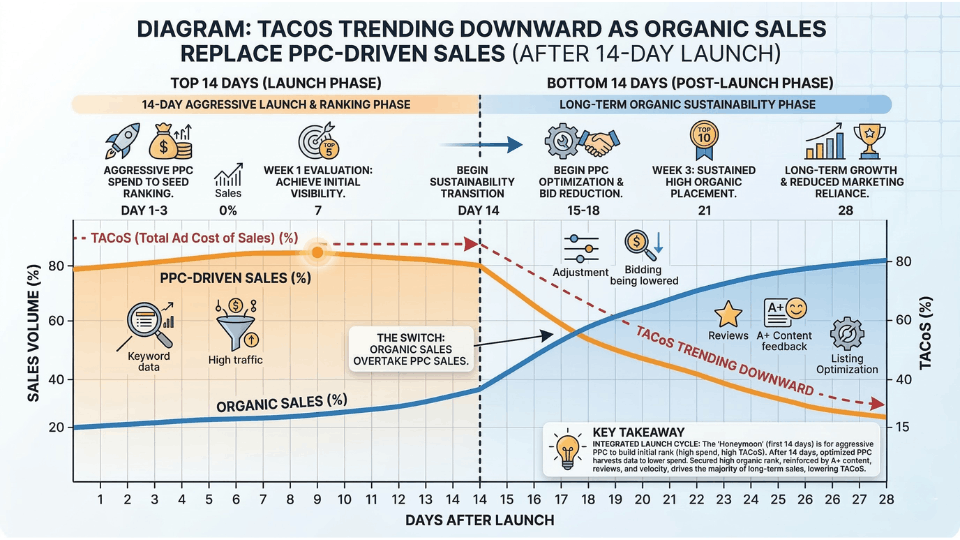
If you have achieved page one organic rank for a keyword, you no longer need to bid aggressively on it. Gradually reduce your bid by 15 to 20% and monitor. If organic rank holds, reduce further. The goal is transitioning from paid to earned visibility. Watch your TACoS — it should be declining as organic sales replace ad-driven ones.
Test and Refine Your Listing for Better Conversion
Twelve days of traffic data gives you real insight. If conversion rate has plateaued, consider testing your main image or title using Amazon's Manage Your Experiments tool, available for Brand Registered sellers. Vikram Patil from Nagpur ran a main image test starting on day 13. His TACoS dropped from 38% on day 14 to 17% by day 45, with organic sales accounting for 62% of total revenue.
Set Your 30-Day Optimisation Roadmap
Day 14 is not the finish line — it is the end of the sprint and the beginning of the marathon. Set a weekly cadence: review search term reports, adjust bids, track organic rank, request reviews, and monitor inventory. The 14-day launch gives you momentum. The next 30 days are about protecting and compounding what you have built.
Want the exact PPC bid tracking template and weekly review checklist that sellers in our community use? The 3-Day Amazon Business Training includes done-for-you tools designed specifically for Indian Amazon sellers.
How Amazon's A10 Algorithm Decides Your Organic Rank
The Five Signals Amazon Cares About Most
Amazon's algorithm evaluates five core signals: keyword relevance, click-through rate, conversion rate, sales velocity, and customer satisfaction metrics like reviews and return rates. These signals interact — strong CTR paired with poor conversion sends a mixed message. Your 14-day plan needs to optimise all five simultaneously. This is why listing quality must come before traffic, and why review generation runs parallel to PPC.
Why PPC and SEO Are Not Separate Strategies
Think of PPC as the ignition and Amazon SEO as the engine. Every ad-driven sale sends positive ranking signals for the keywords associated with that purchase. This is how PPC accelerates organic ranking — it is not a separate cost centre but an investment in long-term visibility. Indian sellers who treat PPC and listing optimisation as isolated activities consistently wonder why organic rank never materialises despite heavy spend.
Common Amazon Product Launch Mistakes Indian Sellers Make
Launching Without Enough Inventory
Running out of stock during the 14-day window destroys ranking momentum. Amazon interprets a stockout as a signal that your product cannot reliably serve demand. Stock at least 60 days' worth based on aggressive projections. Kavita Singh from Lucknow launched with only 150 units, sold out by day nine, and waited three weeks for her next shipment. By the time inventory arrived, her organic rank had reset to where it started.
Targeting Too Many Keywords at Once
Focus on 10 to 20 high-relevance keywords, not 50 or more. Spreading budget across too many terms means you never generate enough sales velocity on any single keyword to move organic rank. Start narrow, rank for priority terms, then expand once you have a foothold.
Ignoring Listing Quality and Jumping Straight to Ads
PPC cannot fix a bad listing. If your images are poor, your title is keyword-stuffed, or A+ Content is missing, you will get clicks but not conversions. And low conversion rate actively damages your organic rank because the algorithm reads it as a signal that your product does not match buyer intent.
FAQ — Your Amazon Product Launch Plan Questions Answered
How long does the Amazon honeymoon period last, and how do you use it?
The honeymoon period typically lasts 15 to 45 days depending on category. Use it by having your listing fully optimised, PPC campaigns live, and review generation active from day one. The algorithm evaluates your early performance to decide long-term ranking, so front-loading effort during this window builds the strongest foundation.
What is the best PPC strategy for a new Amazon product launch?
Start with auto campaigns for keyword discovery on day one, then add broad and exact match manuals within three days. Bid aggressively for top-of-search on priority keywords. Expect high ACoS initially — treat it as a ranking investment, not a profitability measure.
How does Amazon's A10 algorithm determine organic ranking?
A10 evaluates keyword relevance, click-through rate, conversion rate, sales velocity, and customer satisfaction signals including reviews and return rates. It also increasingly factors in off-Amazon traffic. Products demonstrating consistent demand and strong buyer engagement rank higher.
Can you launch an Amazon product without PPC and still rank organically?
Technically possible but extremely difficult for new listings. Without ad-driven visibility, new products receive almost no traffic. PPC remains the most reliable way to generate early sales velocity that Amazon's algorithm needs before granting meaningful organic ranking.
How many units do you need for an Amazon product launch?
Plan for at least 300 units in low-competition niches and 500 or more for competitive categories. The critical rule is never running out during your first 60 days — a stockout resets ranking momentum entirely.
What budget should Indian sellers set for a 14-day launch?
For moderately competitive categories on Amazon.in, plan ₹1,500 to ₹3,000 per day in PPC spend during the first two weeks. A total launch ad spend of ₹25,000 to ₹45,000 is realistic for most Indian private-label sellers, though highly competitive niches may require more.
Should I use external traffic during my Amazon launch?
Yes. Even modest external traffic from social media, Google Ads, or WhatsApp signals to Amazon that your product has demand beyond the marketplace. This off-Amazon signal strengthens organic ranking and is an underused advantage for Indian sellers.
What is the difference between BSR and organic keyword ranking?
BSR reflects your overall sales volume within a category — it is a sales rank. Organic keyword ranking shows where your product appears in search results for a specific search term. You can have a strong BSR but poor keyword rankings if most of your sales come through ads rather than organic search discovery.
Conclusion
The sellers who build lasting organic rank and those who stay permanently dependent on PPC — the difference comes down to the first 14 days. Prepare your listing before spending a rupee on ads. Launch PPC in a structured sequence. Mine data by day four. Push top-of-search on priority keywords. Track organic movement daily. By day 12, begin transitioning from paid to earned visibility. This is not a hack — it is a system that compounds.
The 3-Day Amazon Business Training gives you the complete launch system — from product selection through PPC mastery to organic rank building — designed for Indian Amazon sellers. If you are serious about launching your next product the right way, this is your starting point.
