

Every Sunday evening, Sundeep Reddy from Warangal used to disappear into a spreadsheet. His private-label kitchenware brand was doing respectable numbers, but holding that position meant hours of grinding work — rewriting listing bullets, checking PPC bids keyword by keyword, scrolling through reviews hunting for patterns. By the time he looked up, the evening was gone and the actual growth work hadn’t even started.
He isn’t alone. For thousands of sellers, the right AI tools for Amazon sellers India can hand back fifteen hours a week that used to vanish into repetitive tasks. The catch is that most guides reviewing these tools are written for American sellers, priced in dollars, and silent on what matters here — regional keywords, festival demand, and rupee margins that don’t survive a heavy software bill. This guide fixes that. We’ll walk from listing copy all the way to PPC bid decisions, and show you where AI earns its place in an Indian seller’s day, and where it quietly costs you money.
Why Indian Amazon Sellers Are Quietly Switching to AI in 2026
The 15-hour week that AI gives back
A typical seller running 1,000-plus monthly orders spends fifteen to twenty-five hours every week on manual listing edits, hourly bid checks, and review reading. None of that is strategy. It’s maintenance — the kind of work that keeps you busy without making you bigger. AI tools collapse that maintenance into a fraction of the time, which is why over 900,000 sellers worldwide adopted AI listing generators in the last year alone. The promise isn’t magic. It’s leverage. You stop doing the work a junior assistant could do and start spending your hours on the decisions only you can make.
Why “global tool, Indian reality” is the real gap
Here’s where most advice falls apart for us. The popular tools price their best features at fifty to several hundred dollars a month, and they’re built around the US marketplace. They don’t understand Diwali demand spikes, Tamil and Hindi search behaviour, or the thin margins Indian sellers protect on every unit. AI tools for Amazon sellers India only pay off when you bend them to local reality instead of copying an American playbook line for line.

What AI Actually Does Well for Amazon Sellers (And Where It Fails)
The four jobs AI genuinely speeds up
Before you spend a rupee, it helps to know what AI is actually good at. Four jobs stand out. It drafts listing copy in seconds instead of hours. It clusters messy keyword lists by search intent so you can see your real targeting tiers. It reads hundreds of customer reviews and surfaces the complaints and praise that should shape your next product decision. And it adjusts PPC bids around the clock against a target you set. For each of these, AI for Amazon product listings and campaigns turns a full afternoon into a fifteen-minute review.
The three things AI still gets wrong
Now the honest part. AI has no live access to Amazon’s search data, so any keyword it suggests on its own may have little real traffic. It writes generic, forgettable copy when you feed it thin inputs — rubbish in, rubbish out. And it will confidently invent product specifications that aren’t true, which on Amazon is a fast route to a suppressed listing. The lesson every experienced seller learns is the same: AI drafts, you verify. Treat its output as a first draft from a fast intern, never a finished page ready to publish.
AI Tools for Amazon Listing Optimization: Better Copy, Faster
Amazon’s own free AI
Start with what you already own. Amazon’s native AI tools for Amazon listing optimization sit inside Seller Central at no extra cost. The Add Products flow can draft a title and description from a single product image or a web URL. Enhance My Listing rewrites weak existing copy. And the A+ Content Manager now uses generative AI to draft headlines and module text. For a new seller, this is the cheapest possible starting point.
Third-party listing AI generators worth knowing
When you outgrow the basics, an Amazon listing AI generator from a specialist tool adds keyword intelligence. Helium 10’s Listing Builder writes and then scores your copy against the keywords it found. Jungle Scout’s AI Assist turns review and keyword data into concrete edits. ZonGuru’s Listing Strength Score shows how your copy stacks up against top competitors before you publish.
Writing for Rufus and COSMO
There’s a newer reason to care about copy quality. Amazon Rufus listing optimization matters now because Rufus, Amazon’s shopping AI, actually reads your listing to answer buyer questions. Natural, question-answering language beats keyword stuffing for these AI systems — the same instinct behind how Amazon’s A9 algorithm ranks listings — so write the way a shopper would ask.
Is Helium 10 worth it just for listings?
Honestly, no. The strong AI listing features sit on Helium 10’s top-tier Diamond plan, which is a heavy monthly cost if listings are your only goal. Meghna Kulkarni from Nashik learned this the practical way — she trimmed a six-listing batch from a full day to thirty minutes using a mid-tier tool plus manual rewriting, without paying for the most expensive plan.

Want a quick way to pressure-test your own copy? Our guide to writing bullet points that convert walks you through the exact gaps AI tends to miss.
Free AI Tools for Amazon Sellers: ChatGPT and Claude on a Budget
What the free tiers actually handle
You don’t need a subscription to start. The free tiers of ChatGPT and Claude handle a surprising amount of real work: generating title and bullet variations for split testing, drafting professional supplier emails, clustering a large keyword list by intent, and summarising what hundreds of reviews are really saying. For a seller watching every rupee, these free AI tools for Amazon sellers cover most day-one needs.
Smart prompting beats expensive tools
The difference between useless and useful output is the input. Using ChatGPT for Amazon sellers works when you feed it real data — your verified keyword list, your competitor’s weak points, your actual product specs — and ask for specific deliverables. A vague prompt gives you vague copy. A precise prompt with real keyword research attached gives you a draft you can refine in minutes.
The “start free, graduate later” rule
Faizan Qureshi from Bhopal ran his entire first listing on free ChatGPT plus Amazon’s native generator and spent nothing on software. He only added a paid tool months later, once he could measure the hours it saved. That’s the rule worth following: start free, and graduate to paid tools only when you can point to the time saved or the revenue gained. Don’t buy the dashboard before you’ve outgrown the free one.
Amazon PPC AI Tools: From Manual Bids to Automated Decisions
Can AI optimise bids automatically?
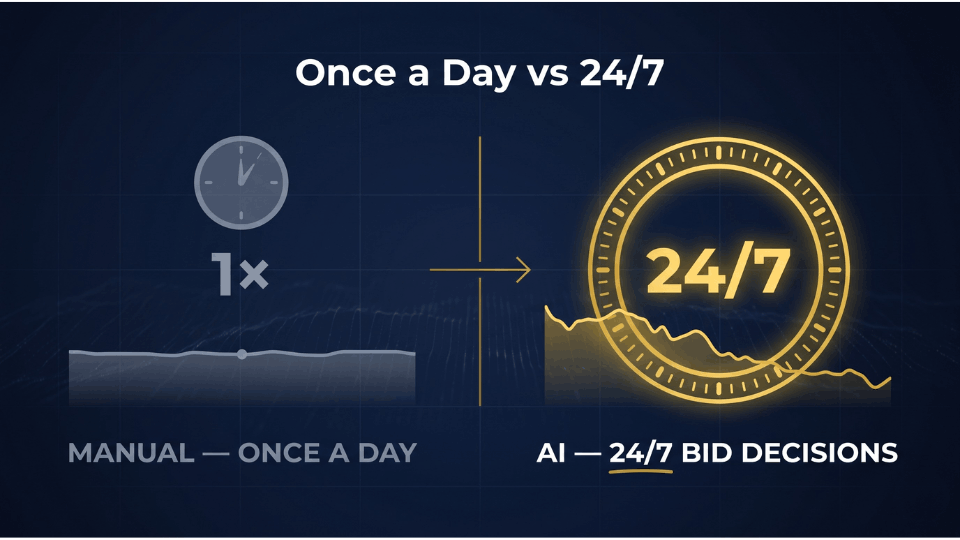
Yes, and this is where AI earns its keep fastest. Manual bidding means logging into Seller Central once a day and reacting to yesterday’s numbers. Amazon PPC AI tools monitor your campaigns around the clock and adjust bids in real time against the ACOS target you set. During launches, competitor promotions, and festival spikes, that hourly responsiveness is the difference between a profitable campaign and a budget bonfire. If you’re newer to ads, our day-by-day budget and bid plan shows what to set before you automate.
Rule-based vs machine-learning automation
Not all automation is equal. Rule-based tools give you transparency and tight control, which suits smaller sellers who want strict budget limits. Machine-learning systems predict trends and manage complex bidding across large catalogs with less hand-holding, which suits high-volume brands. Pick the one that matches your data volume, not the one with the flashiest dashboard.
The pricing trap to avoid
Read the pricing model carefully. Amazon PPC bid optimization software usually charges either a flat monthly fee or a percentage of your ad spend. The percentage model looks small until your spend scales and the bill balloons with it. Flat-fee pricing protects you as you grow, which is why scaling sellers tend to prefer it.
Where the popular tools fit
Tarun Sethi from Faridabad moved from dayparting-blind manual bids to an ACOS-target tool and cut his wasted spend noticeably within weeks. Helium 10’s Adtomic suits sellers already inside that ecosystem; specialists like SellerApp and Sellermate.ai go deeper on automation alone.
If PPC is where you’re bleeding budget, the only 3 campaigns you need breaks down the exact structure to set before you automate anything.
Building Your AI Stack as an Indian Seller (Without Overspending)
A budget-tiered stack
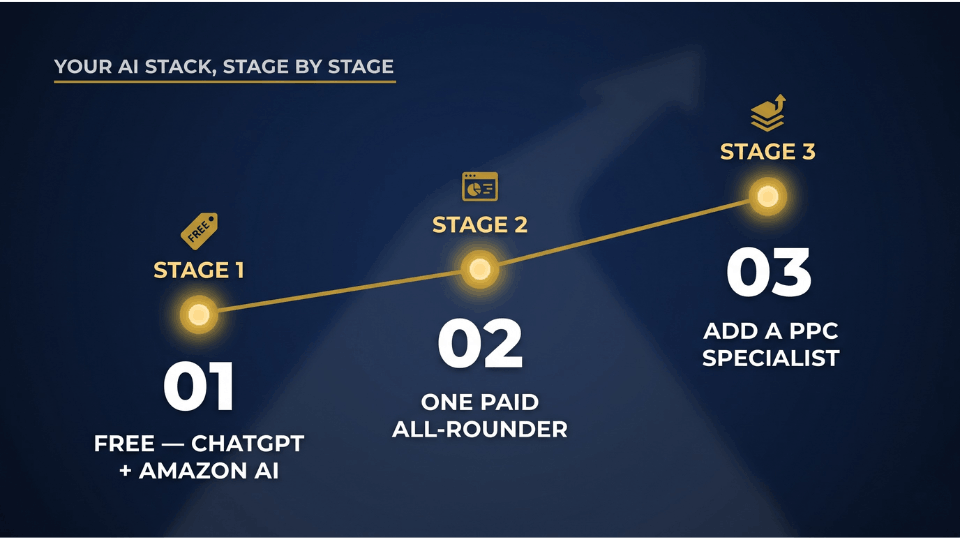
You don’t need every tool. You need the right one for your stage. Build in three stages:
- Stage 1 — free: ChatGPT or Claude plus Amazon’s native listing AI. Zero software cost while you learn what AI does well.
- Stage 2 — one paid all-rounder: A single tool like Helium 10 or Jungle Scout once research and listings demand real keyword data.
- Stage 3 — add a PPC specialist: A dedicated bid-automation tool once your ad spend is large enough to justify it.
Add the next stage only when the current one starts to limit you, never before.
The India layer no tool gives you
No global tool understands Indian search behaviour, festival demand cycles, or regional competitor pricing. That judgement is yours to add on top of whatever AI suggests. The seller who layers local knowledge over AI output beats the one who copies an American template.
Break-even maths in rupees
Anjali Mahato from Ranchi held off on a paid PPC tool until her ad spend crossed roughly two and a half lakh rupees a month — the point where saving twenty to thirty percent on ACOS clearly outweighed the subscription. Run that same simple sum before you subscribe to anything.
Does Amazon Allow AI-Generated Content? Staying Compliant in India
The text rule
Yes, with conditions. Amazon’s 2026 policy permits AI-generated listing text as long as it meets the same quality and accuracy standards as human-written copy. There’s no requirement to disclose that text was AI-assisted, but you remain fully responsible for every claim. An invented specification is your liability, not the tool’s.
The stricter image rule
Images are tighter. Amazon allows AI to enhance photos, build lifestyle backgrounds, and create infographic overlays, but substantial AI modification triggers a disclosure obligation, and your main image must still represent the real product — which is why better product photography still matters even in an AI workflow. You cannot generate the product itself from scratch if it misrepresents what the buyer receives.
The human-in-the-loop habit
The safest workflow is simple: review every AI output before it goes live. Vivek Menon from Kozhikode caught a hallucinated material claim in an AI-drafted bullet during a final check — a thirty-second review that saved him a suppressed listing. One suppressed listing costs far more than the minutes that review takes. Build the check into your routine and AI stays an asset, never a risk.
Frequently Asked Questions
Does Amazon allow AI-generated listing content?
Yes. Amazon permits AI-written titles, bullets, and descriptions as long as they meet its quality and accuracy standards. You don’t have to disclose that text was AI-assisted, but you’re responsible for every claim — so verify specifications and avoid anything the product can’t actually deliver.
What is the best free AI tool for Amazon sellers?
For most sellers, the free tiers of ChatGPT and Claude cover the essentials: listing drafts, keyword clustering, supplier emails, and review analysis. Paired with Amazon’s own native listing AI inside Seller Central, you can run your first listings without spending anything on software.
Is Helium 10 worth it just for the AI listing features?
Not on its own. Helium 10’s strongest AI listing tools sit on its top-tier Diamond plan, which is expensive if listings are your only need. It’s worth it when you also use its research, analytics, and advertising tools. For listings alone, a focused cheaper tool usually delivers better value.
Can AI optimise Amazon PPC bids automatically?
Yes. PPC automation tools monitor campaigns around the clock and adjust bids against the ACOS target you set, instead of the once-a-day manual checks most sellers do. This matters most during launches and festival spikes, when bids need to react in real time rather than the next morning.
Which AI tools work specifically for Amazon India?
Most AI tools are marketplace-agnostic and work fine on Amazon India. The gap is local context — regional keywords, festival demand, and competitor pricing — which no global tool fully understands. Use the tools for speed, then layer your own India knowledge on top of every suggestion.
Will AI-written listings hurt my Amazon ranking?
Not if the copy is good. Amazon ranks on relevance and conversion, not on whether a human or AI wrote the words. Thin, generic, keyword-stuffed copy hurts you regardless of source. Well-researched, natural, verified AI copy can rank just as well as anything written by hand.
Do I need to disclose AI-generated images on Amazon India?
If AI substantially modifies an image, treat disclosure as required, and your main image must still show the real product. Background enhancement and lifestyle scenes are generally fine, but generating a product that misrepresents the actual item is not.
How much should a new Indian seller spend on AI tools?
Start at zero. Use free AI plus Amazon’s native tools until you can clearly measure time saved or revenue gained. Add one paid all-rounder next, and a PPC specialist only once your ad spend is large enough to justify the cost.
Conclusion: Let AI Draft, You Decide
Think of AI as the fastest junior assistant you’ll ever hire — quick, tireless, and genuinely useful, but never the one who signs off on the final page. The sellers pulling ahead in 2026 aren’t the ones who automate everything blindly. They let AI handle the speed-work of drafting copy and adjusting bids, then keep their own judgement on accuracy, compliance, and the India-specific calls no global tool can make. Start with the free tools, prove the value in your own numbers, and add paid tools only when the maths is obvious. Master that balance and you’ll get your Sunday evenings back without giving up an inch of control. If you want a guided path to building this the right way, the 3-Day Amazon Business Training program walks you through it step by step.
