

Meghna Iyer ran her Coimbatore home-fragrance brand the way most first-time sellers do — alone, at 11 p.m., copy-pasting tracking numbers into customer replies while her growth ideas sat untouched. She wasn’t short on ambition. She was short on hands. If you’ve hit that same wall, knowing how to hire an Amazon virtual assistant is one of the highest-leverage moves you can make. Done well, it buys back your week. Done badly, it adds a salary and a headache. The day Meghna realised she’d spent four hours on listings instead of planning her festive-season launch, she finally asked the question every growing seller reaches: should I get help? This guide walks through the whole thing — the roles a VA can take on, what you should realistically pay in India, and the SOPs that turn a new hire into someone you trust. Let’s start with the part most sellers get wrong: timing.
When You Know It’s Time to Hire Your First Amazon VA
Knowing when to hire a virtual assistant matters more than knowing how — too early and you pay someone to watch you figure things out, too late and you’ve already spent months as your own bottleneck.
The tasks quietly eating your week
The work that pushes sellers toward a VA is rarely dramatic. It’s the slow drip — confirming orders, answering the same three customer questions, checking stock, downloading reports. None of it is hard, all of it is repetitive, and every hour there is an hour not spent on sourcing, pricing, or launches. If your evenings are full but your business hasn’t moved, that’s the tell.
The real cost of being your own everything-person
Faizan Qureshi from Lucknow tracked his time for one week and found nearly eleven hours went to tasks any trained assistant could handle. At a fair value on his own time, he was paying himself a premium wage to do data entry. The math is uncomfortable but clarifying: if your time is worth more than a VA’s rate, doing their work yourself is a loss, not a saving.
Signs you’re actually ready (not just busy)
Busy and ready aren’t the same thing. You’re ready when you have repeatable tasks, a small cash cushion, and at least a rough idea of how each task should be done. If your processes live only in your head and change daily, fix that first — handing chaos to a new hire just multiplies it.

What an Amazon Seller Virtual Assistant Actually Does
An Amazon seller virtual assistant is a remote team member who handles the operational work of running your store so you can focus on decisions only you can make. The range of Amazon virtual assistant tasks is wider than most first-timers expect.
Core tasks you can hand over from day one
Start with work that’s high-volume and low-judgement: listing edits, inventory monitoring and reorder alerts, order and return processing, routine customer messages, and basic keyword research. These have clear right answers, which makes them easy to document and easy to check. Devika Nair from Kochi handed over exactly this bundle in her first month and reclaimed her mornings entirely. For the full menu, our guide to essential tasks you can delegate breaks them down.
Specialised work to delegate later
Once trust is built, you can move into higher-skill territory — managing PPC campaigns, supplier outreach, A+ content briefs, and competitor research. These need a VA with specific experience or deeper training, so they’re rarely a day-one ask.
What you should always keep in-house
Some things shouldn’t leave your desk: overall strategy, pricing decisions, financial controls, and your primary account credentials. A VA can execute inside your account through controlled access, but the keys, the direction, and the money stay with you. Delegation means handing over tasks, not handing over the business.
Roles and Responsibilities: Generalist or Specialist First?
Once you know which tasks to delegate, the next question is who to. Amazon virtual assistant roles and responsibilities split broadly into two types, and picking the wrong one for a first hire is a common, expensive mistake.
Why most first hires should be generalists
A generalist handles a bit of everything — listings, customer service, inventory, admin. For a first hire this is usually right. Your business at this stage has many small needs rather than one deep one, and a flexible generalist covers them without you juggling three contractors. You don’t need a big team to build your brand — you need one reliable pair of hands.
When a specialist makes more sense
Sometimes one task is clearly your bottleneck. If PPC is bleeding money or your listings badly need optimisation, a specialist earns their rate fast. Harpreet Gill from Ludhiana skipped the generalist route and hired a dedicated PPC VA because ad spend was his single biggest leak — within six weeks his ACoS had dropped meaningfully.
A quick role-fit checklist
Decide by asking three questions: What single task is costing me the most right now? Do I have enough varied small tasks to keep someone busy? Can I train this person, or do I need someone who already knows it? Pain spread thin means generalist; pain that’s concentrated and technical means specialist.
Amazon Virtual Assistant Pay Rates in India (and What Drives Them)
Money is where first-time hirers get nervous, often because the figures online are wildly inconsistent. Foreign agency pages quote monthly rates that look terrifying until you realise they’re priced for Western clients. The real Amazon virtual assistant salary in India picture is far more reasonable.
What Indian Amazon VAs actually earn
General virtual assistants in India tend are mostly paid on an hourly basis based on the task they take. With Amazon-focused remote support typically landing in the high-teens to mid-twenties thousands, depending on hours and experience. A part-time beginner starts lower; a seasoned VA running your PPC and listings sits at the top of that band or beyond. Treat these as ranges, not fixed prices.
Hourly vs monthly vs per-task pricing
You’ll see three models. Hourly suits irregular, lighter workloads. A monthly retainer suits steady, ongoing work and usually buys you priority and consistency. Per-task pricing fits one-off projects like a batch of listing optimisations. For a first hire doing daily operations, a monthly arrangement is usually cleanest.
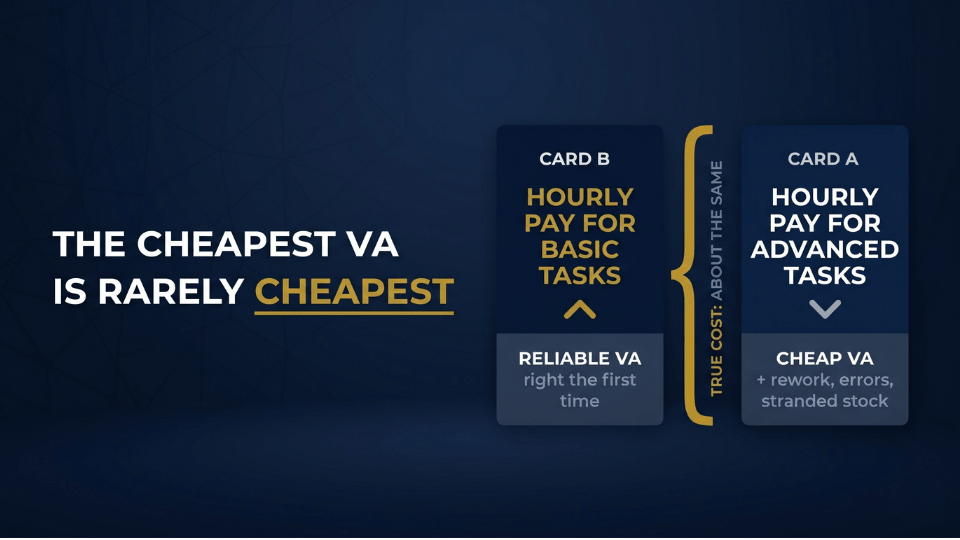
Why the cheapest VA is rarely the cheapest
The lowest Amazon virtual assistant cost almost always carries a hidden bill. Tanvi Desai from Surat learned this when a bargain hire mislabelled a shipment and triggered a stranded-inventory mess that cost more to untangle than a year of the rate difference. Pay for accuracy and communication; a slightly pricier VA who gets it right the first time is the real saving.
Where to Find and Hire an Amazon VA in India
With roles and budget clear, the search begins. There’s no single best place to hire an Amazon virtual assistant in India — only trade-offs between cost, vetting effort, and speed.
Freelance platforms vs agencies vs direct hire
Freelance platforms like Upwork and Fiverr, plus VA-specific boards, give the widest pool at the lowest cost — but you do the vetting. Agencies cost more and handle screening, replacement, and payroll for you. Direct hiring through referrals is cheapest and often highest-trust, though the pool is small. For most first-timers, a platform plus careful vetting hits the sweet spot.
Writing a job post that filters out time-wasters
A vague post attracts vague applicants. Be specific about the tasks, the tools, and the hours — then bury a small instruction inside it, like “start your reply with the word mango,” so you instantly see who actually read it. Karan Mehta from Indore cut his applicant pile by eighty percent with that one trick, keeping only people who follow instructions.
The paid test task that reveals everything
No résumé predicts performance like real work. Give your shortlist a small, paid test — optimise one listing, draft three customer replies, audit a competitor. Paying for it is respectful and filters out the unserious. What one test task reveals about accuracy, speed, and communication is worth more than three interviews.
Before you post that ad, list every task you want off your plate, grouped by how often it happens — that list becomes both your job description and the backbone of your SOP library later. Our AmanCentral operations resources include a task-delegation checklist built for exactly this step.
How to Hire an Amazon Virtual Assistant: The Interview & Trial
You’ve got a shortlist and test results. Now comes the decision. The interview-and-trial stage is where you separate someone who interviews well from someone who works well.
Scenario questions that actually reveal skill
Skip the trivia. Ask how they’d handle real situations: a listing goes suppressed on a Sunday, a customer leaves an angry review over a delayed order, inventory suddenly reads zero. Their answers show how they think under pressure, not what they memorised. Nandini Rao from Mangalore says her best hire was the one who, mid-interview, asked her a sharper question back.
Running a paid trial week
Before committing long-term, run a one-to-two-week paid trial on real tasks. This is the truest signal you’ll get — how they communicate, whether they hit deadlines, how they handle correction. Treat it as a two-way audition; they’re testing you too. Most mismatches reveal themselves inside this window, before they turn costly.
Red flags worth walking away from
Some signals deserve respect. Slow or vague communication during the trial only worsens later. Overpromising on everything, defensiveness when corrected, and reluctance to follow your documented process are all warnings. A great VA asks clarifying questions and admits what they don’t know. Confidence without curiosity is the pattern to avoid.
SOPs That Actually Work: Training a VA Who Sticks
Here’s the truth most hiring guides skip: the quality of your VA depends less on who you hire and more on how you train them. A solid SOP for an Amazon virtual assistant is what turns a capable stranger into a reliable teammate.
The 5-part SOP structure (objective, tools, steps, outcome, video)
A good SOP isn’t a wall of text. It answers five things: the objective (what “done” looks like), the tools needed, the step-by-step process, the expected outcome, and a short video showing it in action. That structure removes guesswork. When your VA can answer “did I do this right?” without messaging you, the SOP is working.
Text + Loom video — the combo that beats both alone
Written steps tell; video shows. Record your screen with a tool like Loom while you do the task once, narrating as you go, then pair it with a written checklist. The video captures nuance words miss; the checklist makes it scannable later.
Building a living SOP library
Write each SOP once and you’ve built an asset, not just a lesson. Store them in one shared place — a folder, Notion, or your task tool — and update them as Amazon changes. The real payoff comes later: when you hire your second VA, your SOP library trains them for you, turning a week of hand-holding into a day of reading.

Writing SOPs is easier when you’re not staring at a blank page. A small swipe file of sample procedures — one for listing edits, one for customer replies, one for inventory checks — gives your VA templates from day one. Start with your three most-repeated tasks.
Managing Your VA for the Long Run: KPIs, Rhythm & Security
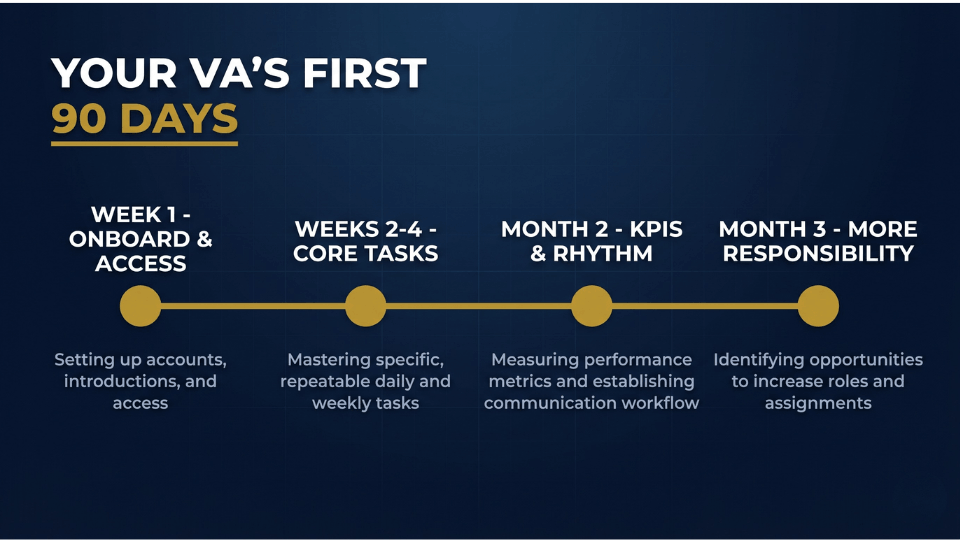
Hiring is the start, not the finish. The sellers who keep great VAs for years do three unglamorous things well: they measure, they communicate, and they protect their account.
KPIs that matter (not vanity metrics)
Track outcomes, not activity, and watch the key metrics worth monitoring. Useful metrics are concrete: listings updated per week, average customer-message response time, errors caught before they ship. These tell you whether the work is moving the business. Avoid vague measures like “hours logged” — a VA can be busy for eight hours and move nothing.
A communication rhythm that prevents drift
A short weekly check-in plus an async channel — Slack, WhatsApp, or a task tool like Asana — keeps everyone aligned without constant pinging. Ritika Bansal from Jaipur runs a ten-minute Monday call with her VA and says it heads off almost every misunderstanding before it starts.
Account security when someone else has access
Never hand over your master login. Seller Central lets you create user permissions, so give your VA access only to what they need and nothing more. Keep two-factor authentication on, review login activity occasionally, and revoke access the moment someone leaves. Trust your VA, but protect the asset that pays you both, and build the habits that keep your seller account safe.
Frequently Asked Questions
What does an Amazon virtual assistant do?
An Amazon virtual assistant handles the operational side of your store remotely — managing and optimising listings, monitoring inventory, processing orders and returns, answering customer messages, doing keyword research, and supporting advertising. The exact mix depends on your needs. The point is to take repetitive work off your plate so you can focus on growth.
How much does it cost to hire an Amazon VA in India?
It varies with experience, hours, and task complexity. General VAs in India tend to average around ₹20,000 a month, with Amazon-focused support often landing in the high-teens to mid-twenties thousands for steady work. Part-time beginners cost less; PPC or sourcing specialists cost more. Think in ranges, and price for reliability.
When should I hire my first Amazon VA?
Hire when you have repeatable tasks eating hours you’d rather spend growing, a small cash cushion to cover the role, and a rough sense of how each task should be done. If your time is worth more than a VA’s rate and you’re your own bottleneck, you’re ready. Document your processes first.
Where can I find a reliable Amazon VA in India?
Three main routes: freelance platforms like Upwork and Fiverr, dedicated VA agencies that handle vetting and replacement, and direct hiring through referrals. Platforms offer the widest pool at low cost but need screening; agencies cost more but save effort. Whichever you choose, run a small paid test task first.
How do I train an Amazon VA with SOPs?
Create a standard operating procedure for each recurring task using a five-part structure: objective, tools, steps, expected outcome, and a short screen-recorded video. Pair written checklists with Loom walkthroughs, have your VA restate the steps back, and store everything in one shared place. Update SOPs as your business and Amazon’s rules change.
How many hours a week should I hire a VA for?
Most sellers start with ten to twenty hours a week for general support, then scale as workload and trust grow. Starting part-time lets you test the relationship, refine your SOPs, and confirm there’s enough work before going full-time. It’s always easier to add hours than to walk them back.
What skills should I look for in an Amazon VA?
Familiarity with Seller Central, clear written English, attention to detail, and the ability to follow a process without constant supervision. Attitude matters just as much — trainability, honesty about gaps, and reliable communication. Tool experience helps, but a careful, coachable generalist often beats a sloppy expert.
Can I safely give my VA access to my Seller Central account?
Yes, if you do it right. Never share your master login. Use Seller Central’s user permissions to grant access only to the areas they need, keep two-factor authentication on, review login activity periodically, and remove access when the relationship ends. Controlled access lets them work without exposing your whole business.
Conclusion
Hiring your first Amazon virtual assistant isn’t really about offloading busywork — it’s the first time you find out whether you can build a system instead of being one. Meghna, Faizan, and the other sellers here all hit the same wall, and the ones who broke through did it by documenting their work, delegating with clear SOPs, and trusting the process they built. Start small, hire for reliability over rock-bottom rates, and train properly. If you want a structured path to building an Amazon business that runs without you stuck in the daily grind, the3-Day Amazon Business Training program walks you through the systems that make delegation work. Your future self — the one with free evenings — will thank you.
