

Aditya Menon from Kochi had a problem he couldn’t name. His stainless steel water bottles were well made, fairly priced, and stuck on page four while flimsier competitors outsold him three to one. So he did what thousands of sellers do when they’re short on time: he opened ChatGPT, pasted his specs, and asked it to write his listing. The copy looked clean. It also sank without a trace.
If you’ve ever used ChatGPT for Amazon listings and felt the output was technically correct but somehow lifeless, you already understand Aditya’s frustration. AI can draft a listing in seconds. The catch is that buyers — and increasingly Amazon itself — can smell generic AI copy from across the page. This guide shows you how to use both ChatGPT and Claude to write listings that read like a sharp human wrote them, and that actually move products.
Why AI-Written Amazon Listings Sound Like AI
What buyers and Amazon spot in two seconds
Generic AI copy has a fingerprint. It reaches for words like “revolutionize,” “seamlessly,” and “elevate,” it stacks sentences of identical length, and it stays so polite and balanced that it carries no point of view at all. A shopper scrolling on a phone doesn’t analyse this consciously. They just feel that the listing is hollow and keep scrolling.
The feature-dump trap
Ask a model for bullet points cold, and it will list specifications: capacity, material, dimensions. What it won’t do, unless you push it, is connect those specs to a reason to buy. “Double-walled insulation” means nothing. “Your chai stays hot from the morning meeting until lunch” means something.
What hollow copy actually costs
Aditya’s original AI listing wasn’t wrong — it was forgettable. When he finally rewrote it around the daily moments his bottle solved, his click-through rate climbed over a single quarter and the listing crawled off page four. The lesson stuck with him: the problem was never the tool, it was handing the tool nothing to work with.

Can ChatGPT Write Amazon Listings That Actually Rank?
What AI does well and badly for Amazon product listings
AI is excellent at structure, speed, and first drafts. It will happily produce ten title variations or rewrite a clumsy paragraph into something readable. What it cannot do is know your market. When sellers ask why their ai amazon product listings underperform, the answer is almost always that the model was guessing at what shoppers search for.
Why the model has no Amazon data
ChatGPT can’t see real search volume, competition, or what’s converting in your category right now. It predicts plausible words, not profitable keywords. Treat anything it suggests about search terms as a brainstorm, not data.
Keyword research first, AI second
Sneha Iyer from Coimbatore learned this the practical way. She used to let ChatGPT invent her keywords; her cotton bedsheets ranked for nothing. Once she pulled real terms from Amazon’s own search suggestions and a keyword tool, then fed those into the model, her listing finally started showing up for the searches buyers actually typed. Do keyword research first, then let AI write around it — and if you want to understand what the algorithm rewards, our guide to how the A9 algorithm ranks listings explains the mechanics.
ChatGPT vs Claude for Copywriting: Which One for What?
The honest answer to the claude vs chatgpt for copywriting debate is that you shouldn’t pick one. They have different temperaments, and the smartest sellers use both.
ChatGPT for speed and structure
ChatGPT is your drafting engine. It’s fast, it follows formatting instructions well, and it’s strong at variations — give it a brief and ask for five title options, and you’ll have raw material in seconds. Its weakness is that left alone, it drifts toward that polished, slightly corporate “AI voice.”
Claude for natural tone and flow
Claude tends to write with more warmth and rhythm. Hand it a flat draft and ask it to make the copy feel human, and it’s better at talking about the actual moment a product solves a problem rather than dumping adjectives. Farhan Qureshi from Lucknow, who sells handcrafted leather wallets, started drafting in ChatGPT and polishing in Claude. The descriptions stopped reading like a brochure and started sounding like a craftsman describing his own work.
The two-model workflow
The combination beats either tool alone: ChatGPT to generate fast, Claude to humanize and tighten. One builds the skeleton, the other gives it a voice. Both sit inside a wider kit worth knowing — see our roundup of the best AI tools for Amazon sellers in India.

Feed the Machine First: Context Before Copy
Most disappointing AI copy traces back to a lazy, contextless prompt. The fix is to feed the model everything a good human copywriter would ask for before writing a word.
Brand voice, persona, and banned phrases
Tell the model who you are and who you’re talking to. A short note — your tone, your buyer, and a list of phrases you never want to see — changes the output dramatically. Megha Bhatnagar from Indore, who sells handmade soaps, keeps a three-line brand voice note and a banned-words list (“luxurious,” “premium quality”) that she pastes into every session.
Mine real reviews for language that converts
Your competitors’ reviews are a goldmine. Copy a mix of glowing and angry reviews into the chat and ask the model to pull out the exact phrases buyers use and the objections they raise. That real customer language is what makes copy land — and it pairs well with a deeper teardown, like our walkthrough on how to reverse-engineer a competitor’s product.
Build a reusable source brief
Save all of this once as a single brief and reuse it per product. You’re not starting from zero each time — you’re handing the model your accumulated knowledge.
ChatGPT Prompts for Amazon Sellers That Don’t Produce Slop
Good chatgpt prompts for amazon sellers share a pattern: they carry keyword data, brand context, and real customer objections inside the prompt itself. Once your source brief is ready, work through the listing in four focused passes rather than one giant request — the same discipline behind bullet points that convert browsers into buyers:
- Title: Ask for several variations that front-load your primary keyword and respect Amazon.in’s character limits, written for a human to read, not a keyword machine.
- Bullet points: Request a feature-to-benefit structure, one long-tail keyword woven naturally into each bullet, with the benefit leading and the spec supporting it.
- Description or A+ copy: Ask it to expand the bullets into persuasive prose that restates benefits in more detail and answers the objections you pulled from reviews.
- Backend search terms: Have it generate relevant terms that didn’t fit the visible copy, with no repetition of words already used in the title.
Run each pass separately so you can correct course before the next. Karthik Reddy from Hyderabad, who sells phone accessories, switched from one mega-prompt to this four-step rhythm and found his bullets stopped reading like a spec sheet and started reading like answers to real questions.
How to Make AI Writing Sound Human (The Edit Pass)
Even with a great prompt, raw AI output needs a human edit. This pass is where you make ai writing sound human — and it’s the step most sellers skip.
Cut the AI vocabulary
Strip the superlatives and the filler. “Revolutionary,” “seamlessly,” “unleash,” “elevate” — delete them. If a sentence survives without the buzzword, it didn’t need it.
Vary the rhythm
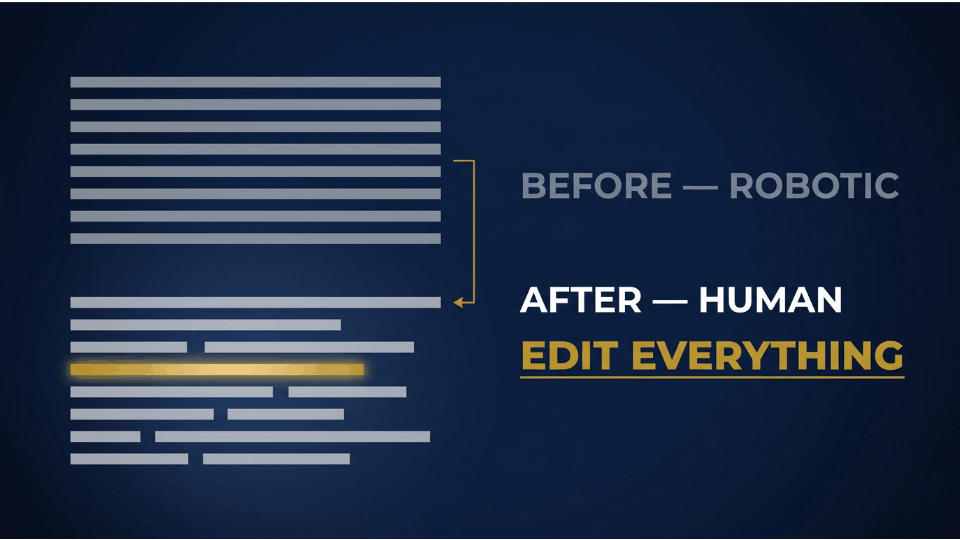
AI writes paragraphs of identical sentence length, and the sameness is what reads as robotic. Put a short, punchy line next to a longer one. The unevenness is what makes it sound like a person.
Add concrete specifics
Generic claims are forgettable; specifics convince. Swap “long-lasting battery” for “charges your earbuds twice on a single top-up.” Ritika Joshi from Dehradun rewrote her yoga mat listing this way — naming the exact non-slip feel during a sweaty session — and watched returns drop because buyers finally knew what they were getting.
The three-pass humanize prompt
Hand your draft to Claude and ask it to work in three passes: first diagnose every robotic tell, then rewrite for a real human reader, then tighten. The diagnosis step is what makes the rewrite honest instead of cosmetic. The rule is simple: Edit it. Never publish raw output.
Will Amazon Penalize AI-Generated Listings?
This is the fear that keeps cautious sellers from using AI at all — and it’s mostly misplaced.
Amazon’s actual stance
Amazon itself offers AI tools that help sellers generate listing copy. The platform isn’t hunting for AI-written words and punishing them. Using a model to draft your listing is not against the rules.
Where sellers really get flagged
The risk isn’t AI — it’s what unedited AI lets slip through: inaccurate specifications, exaggerated or unverifiable claims, and restricted terms. Vivek Nair from Thrissur, who sells ayurvedic supplements, nearly got a listing suppressed because his AI draft invented a health benefit he couldn’t substantiate. The model didn’t break a rule; the missing human review did — which is exactly why it pays to know how to avoid common Amazon policy violations.
The human-in-the-loop checklist
Before you publish, confirm every spec is accurate, every claim is defensible, and no restricted or competitor terms slipped in. AI drafts. You verify. Keep that human review step and the order keeps you safe.
From Blank Page to Published Listing
Pulling it together, the workflow is a simple loop you can run for any product, any time.
The loop
Start with real keyword research. Draft fast in ChatGPT using your source brief. Humanize and tighten in Claude. Run the accuracy and claims check. Then publish. The same four moves work whether you’re listing your first product or your hundredth.
Save your assets once
Your brand voice note, banned-words list, and prompt set are reusable forever. Build them once and every future listing gets faster and better.
When to bring in a human expert
Anjali Desai from Surat ran this loop solo for her kids’ clothing range and only brought in help for her highest-revenue listings, where small conversion gains were worth expert eyes. AI handles the volume; a human handles the stakes.

FAQ
Why do AI-written Amazon listings sound robotic?
Because models default to polished, balanced, personality-free prose with uniform sentence lengths and overused words like “seamlessly” and “elevate.” Without your brand voice, real customer language, and a human edit, AI produces the statistical average of every listing it has seen — which sounds like no one and convinces nobody.
Can ChatGPT write Amazon listings that actually rank?
It can write the copy, but it can’t supply the keywords. ChatGPT has no access to live Amazon search volume or competition data, so ranking depends on you doing keyword research first, then feeding those terms into the model. AI writes the listing; your research makes it rankable.
Is Claude or ChatGPT better for product descriptions?
Neither wins outright. ChatGPT is faster and stronger at structure and variations, while Claude tends to produce warmer, more natural-sounding prose. The best results come from using both — draft in ChatGPT, then humanize and polish in Claude.
How do I make AI listing copy sound human?
Edit it. Cut superlatives and filler words, vary your sentence lengths so they don’t all read the same, and replace vague claims with concrete specifics your buyer can picture. A final pass asking Claude to diagnose and rewrite the robotic tells turns an average draft into copy that reads like a person wrote it.
Will Amazon penalize AI-generated listings?
No — Amazon even offers its own AI listing tools. What gets listings suppressed is inaccurate information, exaggerated or unverifiable claims, and restricted terms slipping through unedited. Keep a human review step to check accuracy and compliance, and AI-assisted listings are perfectly safe.
Do I need both ChatGPT and Claude, or is one enough?
One tool works, but two work better. ChatGPT handles fast drafting and variations; Claude handles natural-sounding rewrites. If you only use one, run a careful manual edit to compensate for the strength you’re missing.
Can AI write listings for Amazon.in or in regional languages?
Yes, with supervision. AI can draft for Indian buyers and in languages like Hindi or Tamil, but quality varies and machine-translated copy often reads stiffly. Always have a fluent human review regional-language listings for tone and accuracy before publishing.
How long does this workflow take per listing?
Once your source brief and prompts are saved, a single listing usually takes an afternoon, not a week. The research and brief-building take the most time upfront, but they’re reusable, so every listing after the first goes considerably faster.
Conclusion
AI didn’t kill good listing copy — lazy prompting did. The sellers winning on Amazon treat ChatGPT and Claude as a drafting-and-polishing duo wrapped around their own product knowledge, real keyword data, and a careful human edit. Do the research, feed the machine proper context, let ChatGPT draft and Claude humanize, then verify every claim before you publish. That loop turns AI from a slop generator into a genuine advantage.
If you want to go deeper — not just on listings but on building a profitable Amazon business end to end — our 3-Day Amazon Business Training walks you through the full system, step by step. Your listings, and your bottom line, will thank you.
