
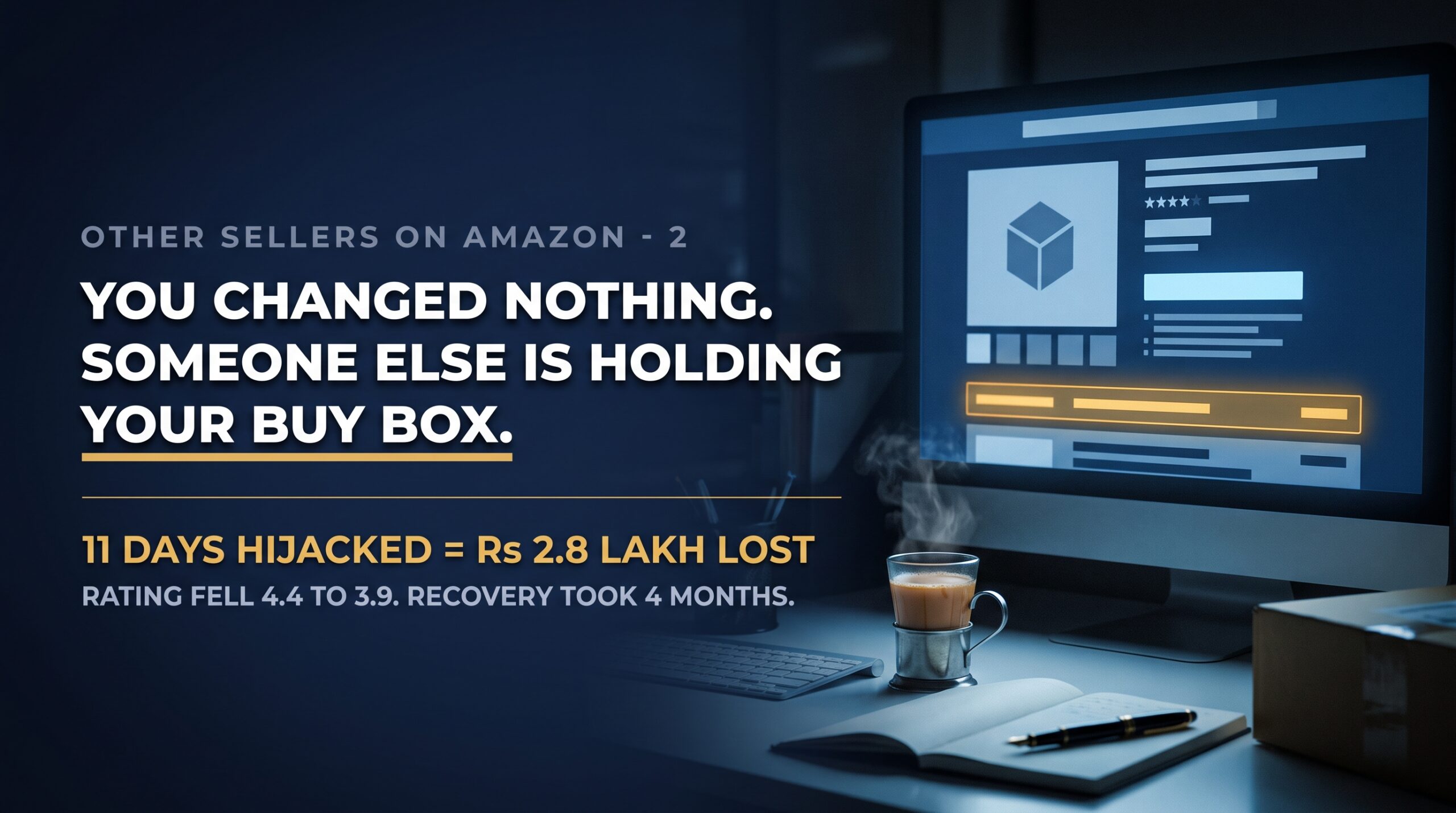
It is 7:40 on a Tuesday morning. You have your chai, you open Seller Central to check yesterday’s orders, and something is off. Sales on your best SKU dropped by two-thirds overnight. You changed nothing. Then you look at the live listing and see it: “Other Sellers on Amazon — 2.” Someone you have never heard of is sitting on your ASIN, underselling you by ₹40, and holding the Buy Box. That cold feeling is why so many brand owners end up searching how to remove hijacker from amazon listing at midnight.
The good news is that this is a process, not a lottery. There is an order to it — evidence first, then reporting, then brand tools, then legal pressure — and sellers who follow that order usually get the offer pulled within days rather than months.
What follows is that exact sequence, written for Indian sellers dealing with Indian invoices, Indian trademarks and Amazon.in support queues. By the end you will know what to do today, what to do this week, and how to make sure it never happens on that ASIN again.
What Listing Hijacking Really Means
The amazon listing hijacking meaning is simpler than the panic suggests. Amazon India runs on one-product-one-page: every ASIN is a shared shelf, and any seller with an active account can attach an offer to it. Hijacking is when someone attaches an offer to your page without permission.
Why hijackers target Indian sellers
Hijackers read the same bestseller charts you do. A private-label SKU doing 600 orders a month at a 35% margin is a ready-made revenue stream — no photography, no reviews to build, no ad spend. They ride your ranking for a few weeks, bank the cash, then abandon the account when complaints arrive. Kitchenware, supplements, phone accessories and skincare take the worst of it.
Hijacker versus legitimate reseller
Not everyone on your ASIN is a criminal. A sub-dealer reselling your genuine stock is an unauthorised reseller, which is a contract problem. A seller shipping fakes under your brand name is a counterfeiter, which is an IP problem. Amazon treats the two very differently, so work out which one you have before writing a single word to support.
The real cost to sales and ratings
Ritu Malhotra sells copper bottles from Jaipur. A hijacker held her Buy Box for eleven days; she lost roughly ₹2.8 lakh in sales and picked up nine one-star reviews about leaking lids from units she never packed. Her rating fell from 4.4 to 3.9 and took four months to recover. The lesson: sales come back quickly, reviews do not.
Warning Signs Someone Has Taken Over Your ASIN
Hijackers rarely announce themselves. They show up as symptoms inside reports you already read, which is why most sellers notice on day nine instead of day one.
You lose the Buy Box without changing price
The clearest signal is a Buy Box you held comfortably disappearing on a day you touched nothing. Compare your offer against the featured offer on the live page. If your price, stock and handling time are unchanged and the Buy Box is gone, another offer is winning it — and you need to know whose.
Odd reviews about quality and packaging
Watch for reviews describing a product you do not make: wrong colour, missing insert, seal broken, packaging that “looks printed at home”. A spike in returns coded defective or not-as-described on an SKU with a stable history is the same alarm wearing a different shirt.
A two-minute daily check that catches it early
Pranav Deshpande, who sells yoga mats out of Pune, opens the offer-listings page for his top five ASINs with his morning coffee. In March he spotted a new FBM offer within four hours of it going live, filed the same day, and had it pulled in 48 hours with zero review damage. Two minutes a day beat a month of firefighting.
So when your gut asks amazon listing hijacked what to do first, the answer is not “email support” — it is “collect proof“.
Build Your Evidence Before You Report
Amazon investigators act on specifics. “This seller is fake” goes nowhere; an order ID, photographs and a batch-code mismatch get action. Spend one day building the file and you save three weeks of escalation.
Place a test buy from the other seller
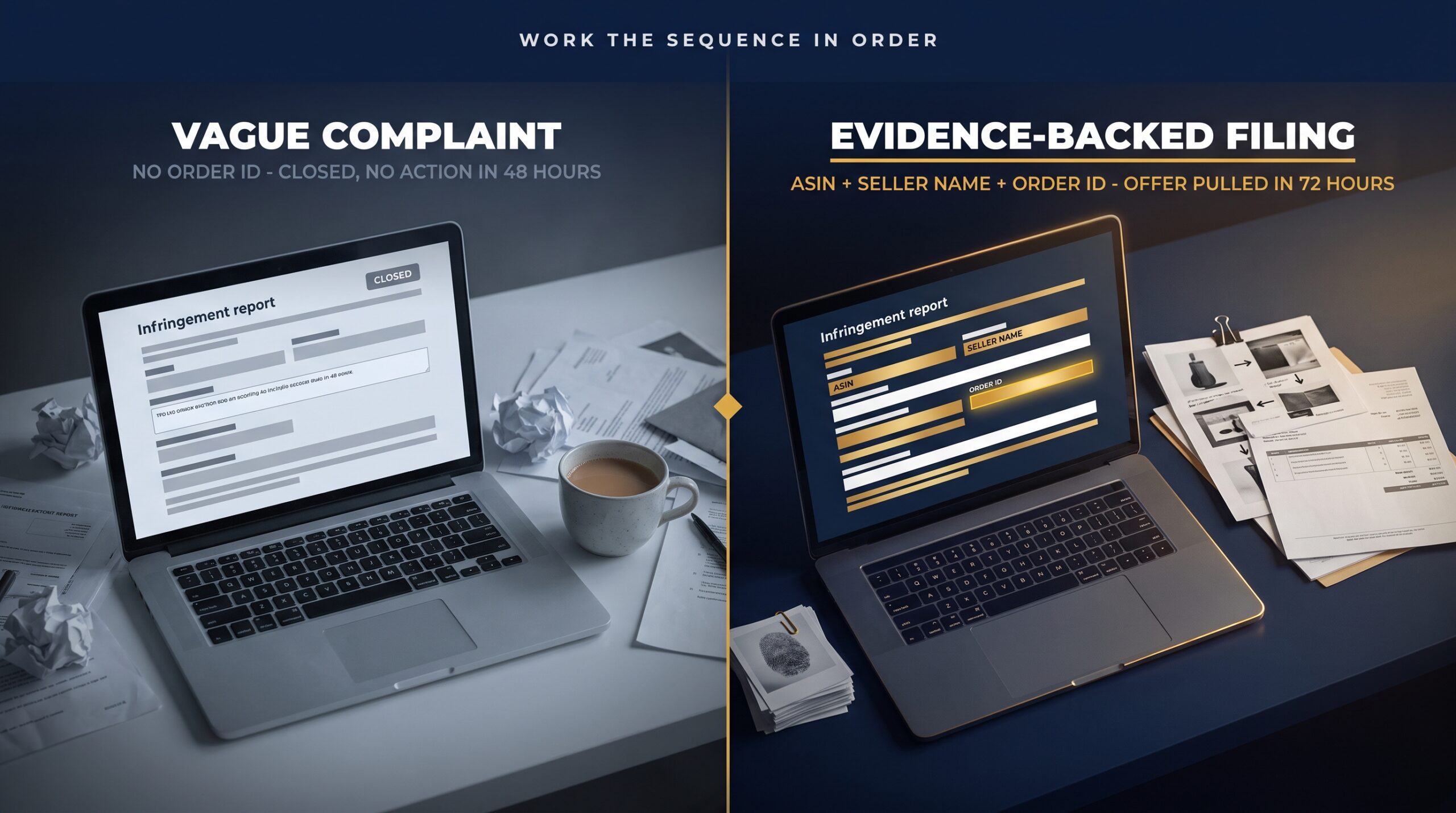
Order one unit from the hijacker’s offer, at full price, to a residential address. Keep the order ID — it is the single most valuable field in any amazon counterfeit complaint asin submission, because it lets Amazon trace the exact unit that shipped. Do not cancel it and do not return it before you have documented everything.
Photograph packaging, labels and invoices
Film yourself opening the parcel. Photograph the carton, shipping label, seller invoice, your logo, the MRP sticker, manufacturing date and batch code. Then place your own genuine unit beside it and shoot the same angles again. Differences in font weight, seal quality or batch format become undeniable side by side.
Save screenshots of the offer and seller page
Harmeet Sethi from Ludhiana captured the offer-listings page and the hijacker’s storefront details, attached fourteen images to one complaint about his leather wallets, and received removal confirmation in five days after two earlier vague tickets had been closed. Evidence, not outrage, moved it.
Before you file anything, your evidence folder should hold:
- The order ID and a dated invoice from the other seller
- An unboxing video showing the sealed parcel being opened
- Photos of their unit and your genuine unit side by side
- Batch code, MRP label and barcode close-ups from both units
- Screenshots of the live offer and the seller’s storefront details
With that folder ready, the reporting step takes fifteen minutes instead of fifteen emails.
How to Remove a Hijacker From Your Amazon Listing
Work the sequence in order, because each step raises the pressure and builds a paper trail that makes the next step stronger.
Message the seller through Buyer-Seller Messaging
Send one short, firm message: you are the brand owner, the ASIN is protected, they are not an authorised reseller, and you expect the offer removed within 48 hours. No threats, no abuse. Many opportunists close the offer immediately once they realise a real brand is watching, because fighting is not worth their thin margin.
File the violation in Seller Central
If the offer is still live, report unauthorized seller on amazon india through the infringement route in Seller Central. Choose trademark or counterfeit as the issue type, enter the ASIN and the seller’s exact name, paste the test-buy order ID, attach your trademark certificate and photographs, and describe the violation in three plain sentences.
Escalate when the first report goes nowhere
Farhan Qureshi, a Hyderabad home-fragrance seller, got a closed-no-action reply on his first filing. He refiled with the order ID he had omitted, referenced the earlier case number, and the offer vanished in 72 hours. If a second filing stalls, escalate through your Brand Registry support dashboard and ask for a named case owner.
Knowing how to remove hijacker from amazon listing threats sits alongside pricing, sourcing and launch planning — all of which we work through together inside the 3-Day Amazon Business Training, where brand protection is built into the plan instead of bolted on later.
Let Brand Registry Do the Heavy Lifting
Support tickets move slowly because the reviewer does not know who you are. Using amazon brand registry to stop hijackers changes that: your claim arrives pre-verified, and removals that took a fortnight start taking days.
What you need to enrol in India
You need a registered or pending Indian trademark, an active seller account, your brand logo as it appears on your products, and images of your branded packaging. The trademark must match the brand name on your listings exactly — a mismatch of even one word is the most common reason applications bounce back and stall for weeks.
Using Report a Violation the right way
Once enrolled, the Report a Violation tool lets you search your own catalogue, select the offending offer and file directly against it. Be precise about the violation type. Filing “counterfeit” when you mean “unauthorised reseller” gets your claim rejected and, if repeated, makes future genuine complaints harder to push through.
Transparency codes and serialised protection
Transparency puts a unique scannable code on every unit, verified before anything ships under your ASIN. Devika Nair, who sells ayurvedic hair oil from Kochi, enrolled her two bestsellers and saw hijacker attempts on those ASINs drop to zero over six months, while an unenrolled SKU was hit twice. Serialisation stops the problem at the door.
Sending a Cease and Desist That Gets Results
Some sellers ignore Amazon’s process entirely and simply open a new account. That is when a cease and desist letter amazon seller india brands send through a trademark attorney becomes the faster lever, because it reaches the human behind the storefront.
What the letter must actually say
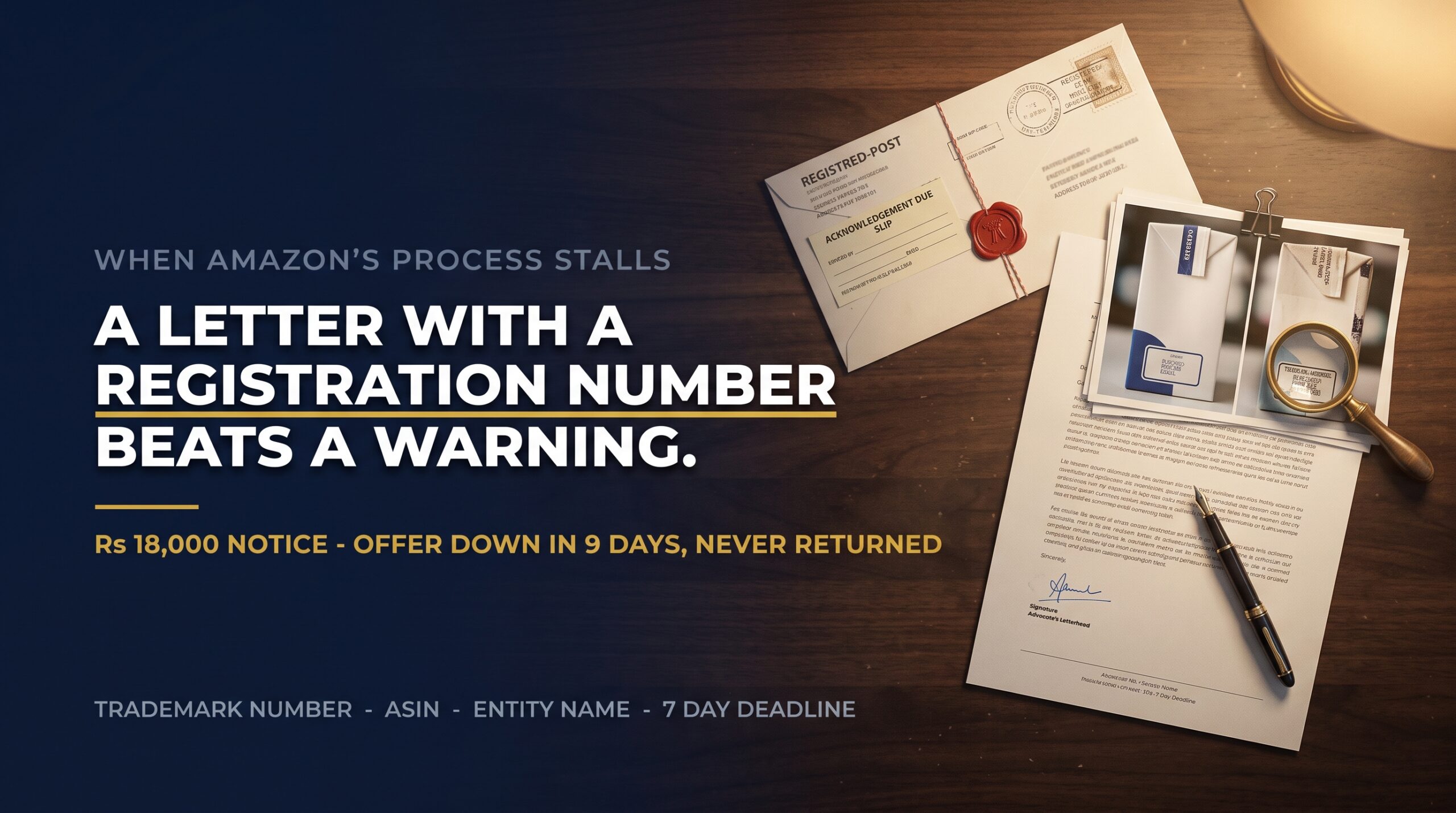
It must identify your trademark by registration number and class, name the ASIN and the seller’s registered business entity, state precisely what they did, and set a deadline — usually seven days — to withdraw the offer and confirm in writing. Attach the test-buy invoice and your comparison photographs. Vague letters get binned; specific ones get replies.
Who should sign and send it
A letter on your own letterhead carries some weight. One on an advocate’s letterhead carries much more. Send it by registered post with acknowledgement due to the GST address on your test-buy invoice, and email a scanned copy the same day so there is no argument about receipt.
When to move beyond a letter
Meenal Joshi, an Indore seller of steel lunchboxes, spent around ₹18,000 on an attorney-drafted notice after three Amazon filings failed. The offer came down in nine days and never returned. If yours ignores the deadline, the next options are an infringement suit and, where fakes are involved, a police complaint. Most hijackers fold long before that.
If the legal and operational side of brand protection feels unfamiliar, that is exactly what we unpack step by step when you sit in on the 3-Day Amazon Business Training.
When the Other Seller Has Genuine Stock
Sometimes the test buy comes back and the unit is yours. Same batch code, same seal, same insert. This is the hardest version of the problem, and the one where sellers waste months filing complaints that will never succeed.
Why Amazon rarely removes a legitimate reseller
Amazon’s policies protect intellectual property, not exclusivity. If a seller bought your genuine goods through a lawful channel and describes them accurately, there is no IP violation to act on. Filing counterfeit claims anyway is how brand owners lose their reporting privileges and, occasionally, their accounts.
Tighten your distributor and invoice trail
The fix sits upstream. Add a written no-marketplace clause to every dealer agreement, stamp carton-level batch codes so you can trace which consignment leaked, and make continued supply conditional on compliance. Arjun Bhatia, a Delhi supplements seller, traced a leak to one Karol Bagh sub-dealer within three weeks using carton codes and cut him off; the offer disappeared the following month.
Win the Buy Box back on merit instead
While you sort out supply, compete properly. Move the SKU to FBA if it is not already, keep stock depth healthy, hold your price within a sensible band and push coupons rather than permanent cuts. Reliable fulfilment and availability win the featured offer far more often than the last rupee of price.
Keeping Hijackers Off Your Listings for Good
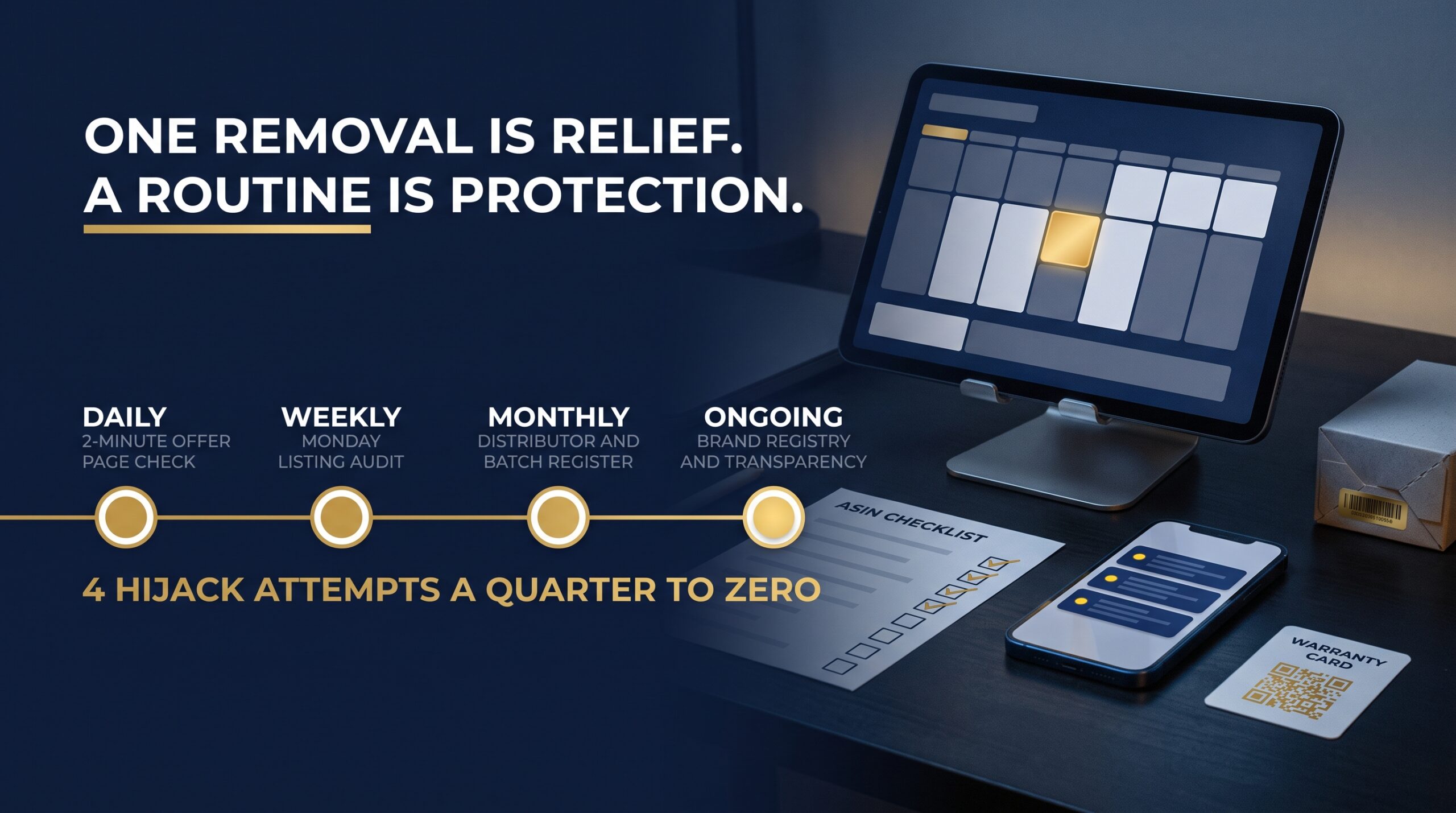
One removal is relief. A system means you never lose eleven days again. Treat the incident as the moment your brand-protection routine was born.
Control who gets your stock and at what price
Decide which channels get your inventory and put it in writing, with minimum advertised pricing and a marketplace restriction for every offline partner. Keep a register of who bought what, in which batch, on which date. When an unauthorised offer appears, that register turns a guessing game into a phone call.
Differentiate bundles, kits and variations
Build ASINs that are hard to copy: a two-piece kit, a size only you produce, a QR-coded warranty card inside the box. Sandeep Kulkarni in Nagpur rebuilt his top pressure-cooker SKU as a cooker-plus-gasket bundle under a fresh ASIN and saw hijacker attempts fall from four in a quarter to none in the following two.
Set up alerts and a weekly listing audit
Use a monitoring tool such as Helium 10‘s alerts to flag new sellers, Buy Box changes and sudden price drops across your ASINs, and add a Monday audit of your offer-listings pages to your calendar. Enrol bestsellers in Transparency as volumes justify it, and keep trademark and Brand Registry records current so you never lose a week to paperwork mid-crisis.
Frequently Asked Questions
What is Amazon listing hijacking and why does it happen?
Amazon uses one product page per item, so any active seller can attach an offer to your ASIN. Opportunists target listings that already rank and convert, earning from your reviews, photography and ad spend. High-margin, fast-moving SKUs in skincare, supplements and kitchenware are hit most often, usually with counterfeits or grey-market stock.
How do I know if my Amazon listing has been hijacked?
Watch for a Buy Box you lose without changing price, stock or handling time, a seller count above one on your offer-listings page, and reviews describing packaging you do not recognise. A sudden jump in returns marked defective on a stable SKU is another reliable signal. Daily offer-page checks catch most cases within hours.
How do I report a hijacker or counterfeit seller to Amazon?
Place a test buy first, then file through the infringement or Report a Violation route in Seller Central. Select the correct issue type, enter the ASIN and the seller’s exact storefront name, include the order ID, and attach your trademark certificate plus comparison photographs. Complaints carrying an order ID get investigated far faster.
Can Amazon remove a seller who is selling my genuine product?
Usually not. Amazon enforces intellectual property rights, not distribution exclusivity, so authentic goods described accurately break no policy Amazon can act on. Your remedies are commercial: marketplace restrictions in distributor contracts, batch codes that identify the leaking consignment, and cutting supply. Meanwhile compete on fulfilment speed, stock depth and sensible pricing.
Do I need a registered trademark and Brand Registry to remove a hijacker?
You can file an infringement report without Brand Registry, but enrolment makes everything faster because ownership is already verified. Enrolment requires a trademark registered or pending in India matching your listed brand name exactly, an active seller account, and images of branded packaging. Registry also opens Report a Violation and Transparency serialisation.
How long does Amazon take to act on a hijacker complaint?
A well-documented complaint with an order ID and photographs commonly gets a decision within three to seven days. Thin complaints are often closed with no action in 48 hours, which achieves nothing. If your first filing stalls, refile with stronger evidence, reference the earlier case number, and ask for a named case owner.
Will a test buy get my money back if the product is fake?
Generally yes. Return the unit through the standard returns process once you have photographed and filmed everything, or claim under the A-to-Z guarantee if the seller refuses. Treat the cost as an investigation expense; one traceable order ID does more for your case than a dozen strongly worded emails.
Can I be suspended for filing a wrong counterfeit complaint?
It is a genuine risk. Alleging counterfeits against sellers offering authentic stock is treated as abuse of the reporting process, and repeat instances can cost you reporting privileges or your account. Always test-buy before you allege fakes, and pick the accurate violation type. Accuracy protects the credibility your next complaint depends on.
Conclusion
A hijacker feels like an emergency the first time and like a Tuesday task the fifth time, and the difference is entirely down to having a routine. Build the evidence folder, file with the order ID attached, get your trademark and Brand Registry paperwork in order, send the attorney’s letter when Amazon’s process stalls, then close the door with differentiated bundles, tighter distribution and weekly monitoring. That is the whole defence, and it works whether you sell 200 units a month or 20,000.
Start today with the two-minute check on your top five ASINs. Then build the rest of the system properly — pricing, sourcing, listing control and brand protection together — by joining us for the 3-Day Amazon Business Training, where you map your defence before you need it.

One Response
Very Useful tips