
Picture this: You're staring at a list of 100 product ideas you've spent days collecting. Each one feels like it could work. The bamboo laptop stand? Sure. The kitchen drawer organizer? Maybe. The cable management bundle? Why not.
But here's the problem — you have no idea which one will actually make money. So you pick the one that feels right. The one you'd buy yourself. The one your friend said was “cool.”
Three months later, you've invested ₹2 lakhs, launched the product, and… silence. A few clicks. A couple of sales. Your inventory sits untouched while competitors with mediocre listings somehow fly off the shelves.
This is the nightmare every Amazon seller fears — and it happens because most people choose products based on gut feeling, not data. The good news? You can avoid this trap completely. The secret isn't better guessing — it's better validation. And in 2026, that means using Helium 10 to turn product selection from a gamble into a science.
Why 90% of Amazon Sellers Pick the Wrong Product
Let's be honest — most sellers don't fail because they're lazy. They fail because they're guessing.
They see a trending product on Instagram, assume there's demand, and launch without checking if customers are actually buying it on Amazon. Or they pick something they're passionate about — handmade journals, eco-friendly water bottles, artisan coffee mugs — without validating if the market cares.
The “gut feeling” trap is real. You get emotionally attached to an idea. You invest time designing packaging, creating mockups, and writing the perfect product description. By the time you realize the market doesn't want it, you're already ₹2 lakhs deep.
Then there's the data blindness problem. Even sellers who try to research often look at the wrong signals. They see high search volume and think “huge demand!” without checking if competition is brutal. They notice low review counts and assume “easy to enter!” without realizing sales are dead.
The consequence? Slow sales. Price wars. Stuck inventory. Burnout.
But here's the truth: the solution isn't better guessing — it's better data. And that's where Helium 10 becomes your unfair advantage.
The 3 Pillars of Winning Products (2026 Edition)
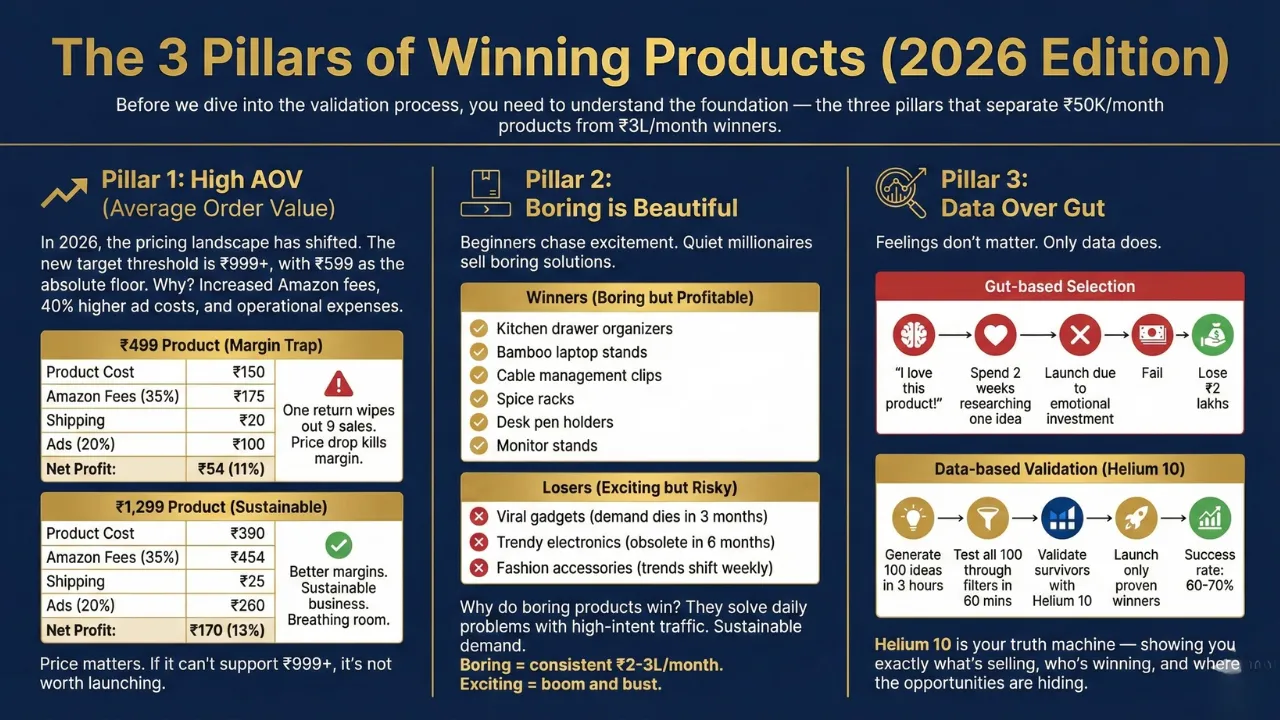
Before we dive into the validation process, you need to understand the foundation — the three pillars that separate ₹50K/month products from ₹3L/month winners.
Pillar 1: High AOV (Average Order Value)
In 2026, the pricing landscape has shifted. What used to be safe at ₹699 is now a margin trap. The new threshold is ₹999+ as your target, with ₹599 as the absolute floor.
Why? Amazon fees have increased. Ad costs are up 40% since 2023. Shipping, packaging, returns — they all eat into your profit. If you're selling a ₹499 product, here's the harsh reality:
₹499 Product:
- Product Cost: ₹150
- Amazon Fees (35%): ₹175
- Shipping: ₹20
- Ads (20%): ₹100
- Net Profit: ₹54 (11%)
One return wipes out 9 sales. One competitor price drop kills your margin.
₹1,299 Product:
- Product Cost: ₹390
- Amazon Fees (35%): ₹454
- Shipping: ₹25
- Ads (20%): ₹260
- Net Profit: ₹170 (13%)
Better margins. More breathing room. Sustainable business.
The bottom line? Price matters more than you think. If your product can't support a ₹999+ price point, it's not worth launching in 2026.
Pillar 2: Boring is Beautiful
Here's what most beginners get wrong — they chase excitement. Viral TikTok gadgets. Trending tech accessories. “Innovative” products nobody asked for.
Meanwhile, the quiet millionaires are selling drawer organizers.
Winners (Boring but Profitable):
- Kitchen drawer organizers
- Bamboo laptop stands
- Cable management clips
- Spice racks
- Desk pen holders
- Monitor stands
- Utensil holders
Losers (Exciting but Risky):
- Viral gadgets (demand dies in 3 months)
- Trendy electronics (obsolete in 6 months)
- Fashion accessories (trends shift weekly)
Why do boring products win? Because they solve daily problems. People don't impulse-buy drawer organizers — they search for them when their kitchen is messy. That's high-intent traffic. That's sustainable demand.
Boring = consistent ₹2-3L/month. Exciting = boom and bust.
Pillar 3: Data Over Gut
This is the pillar that changes everything. Your feelings don't matter. Your friend's opinion doesn't matter. What matters is what the data says.
Gut-based selection:
- “I love this product!”
- Spend 2 weeks researching that one idea
- Launch because you're emotionally invested
- Fail
- Lose ₹2 lakhs
Data-based validation:
- Generate 100 ideas in 3 hours
- Test all 100 through filters in 60 minutes
- Validate survivors with Helium 10
- Launch only proven winners
- Success rate: 60-70%
The tool that makes this possible? Helium 10. It's your truth machine — showing you exactly what's selling, who's winning, and where the opportunities are hiding.
Ready to stop guessing? Get Helium 10 at 40% off here.
The 4 Kill Gates: Your 60-Minute Product Filter
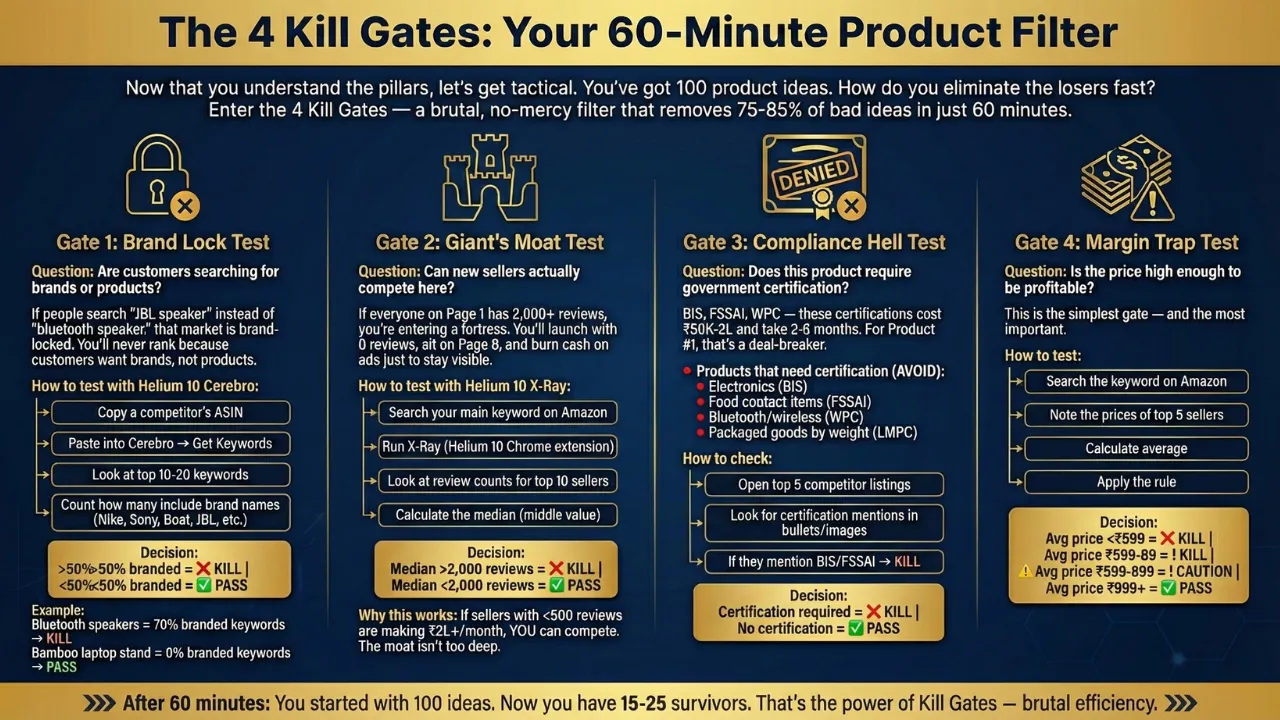
Now that you understand the pillars, let's get tactical. You've got 100 product ideas. How do you eliminate the losers fast?
Enter the 4 Kill Gates — a brutal, no-mercy filter that removes 75-85% of bad ideas in just 60 minutes.
Gate 1: Brand Lock Test
Question: Are customers searching for brands or products?
If people search “JBL speaker” instead of “bluetooth speaker,” that market is brand-locked. You'll never rank because customers want brands, not products.
How to test with Helium 10 Cerebro:
- Copy a competitor's ASIN
- Paste into Cerebro → Get Keywords
- Look at top 10-20 keywords
- Count how many include brand names (Nike, Sony, Boat, JBL, etc.)
Decision:
- >50% branded keywords = ❌ KILL
- <50% branded keywords = ✅ PASS
Example:
JBL Bluetooth speakers = 70% branded keywords → KILL
Bamboo laptop stand = 0% branded keywords → PASS
Gate 2: Giant's Moat Test
Question: Can new sellers actually compete here?
If everyone on Page 1 has 2,000+ reviews, you're entering a fortress. You'll launch with 0 reviews, sit on Page 8, and burn cash on ads just to stay visible.
How to test with Helium 10 X-Ray:
- Search your main keyword on Amazon
- Run X-Ray (Helium 10 Chrome extension)
- Look at review counts for top 10 sellers
- Calculate the median (middle value)
Decision:
- Median >2,000 reviews = ❌ KILL
- Median <2,000 reviews = ✅ PASS
Why this works: If sellers with <500 reviews are making ₹2L+/month, YOU can compete. The moat isn't too deep.
Gate 3: Compliance Hell Test
Question: Does this product require government certification?
BIS, FSSAI, WPC — these certifications cost ₹50K-2L and take 2-6 months. For Product #1, that's a deal-breaker.
Products that need certification (AVOID):
- Electronics (BIS)
- Food contact items (FSSAI)
- Bluetooth/wireless (WPC)
- Packaged goods by weight (LMPC)
How to check:
- Open top 5 competitor listings
- Look for certification mentions in bullets/images
- If they mention BIS/FSSAI → KILL
Decision:
- Certification required = ❌ KILL
- No certification = ✅ PASS
Gate 4: Margin Trap Test
Question: Is the price high enough to be profitable?
This is the simplest gate — and the most important.
Decision:
- Average price <₹599 = ❌ KILL
- Average price ₹599-899 = ⚠️ CAUTION (can work if bundled)
- Average price ₹999+ = ✅ PASS
How to test:
- Search the keyword on Amazon
- Note the prices of top 5 sellers
- Calculate average
- Apply the rule
After 60 minutes:
You started with 100 ideas. Now you have 15-25 survivors. That's the power of Kill Gates — brutal efficiency.
Next step? Deep validation.
Deep Validation: The Two-Pillar Framework
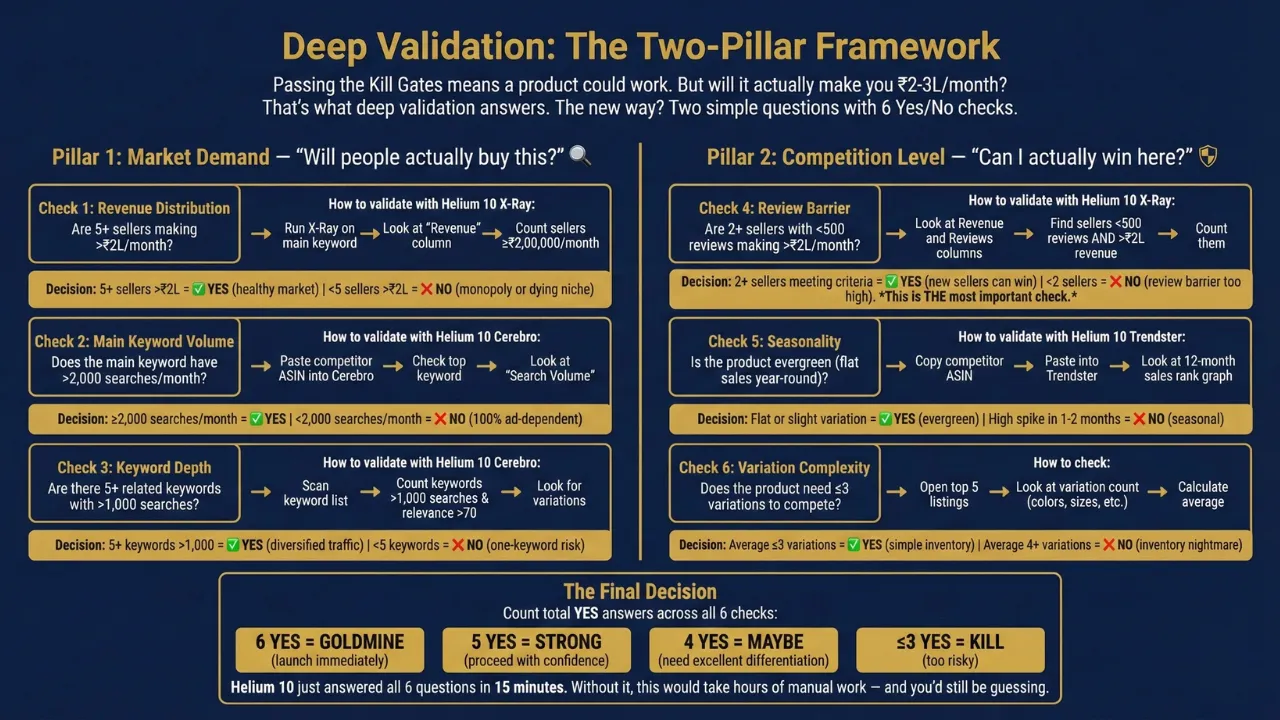
Passing the Kill Gates means a product could work. But will it actually make you ₹2-3L/month? That's what deep validation answers.
The old way was complex — scoring systems, weighted criteria, analysis paralysis. The new way? Two simple questions with 6 Yes/No checks.
Pillar 1: Market Demand — “Will people actually buy this?”
Check 1: Revenue Distribution
Are 5+ sellers making >₹2L/month?
How to validate with Helium 10 X-Ray:
- Run X-Ray on your main keyword
- Look at the “Revenue” column
- Count how many sellers show ≥₹2,00,000/month
Decision:
- 5+ sellers >₹2L = ✅ YES (healthy market)
- <5 sellers >₹2L = ❌ NO (monopoly or dying niche)
Check 2: Main Keyword Volume
Does the main keyword have >2,000 searches/month?
How to validate with Helium 10 Cerebro:
- Paste competitor ASIN into Cerebro
- Check the top keyword (usually the main one)
- Look at “Search Volume” column
Decision:
- ≥2,000 searches/month = ✅ YES
- <2,000 searches/month = ❌ NO
Why 2,000? It's the minimum threshold for sustainable organic traffic. Below that, you're 100% ad-dependent.
Check 3: Keyword Depth
Are there 5+ related keywords with >1,000 searches?
How to validate with Helium 10 Cerebro:
- Scan the keyword list
- Count keywords with >1,000 searches and relevance >70
- Look for variations (bamboo stand, wooden stand, laptop riser, etc.)
Decision:
- 5+ keywords >1,000 = ✅ YES (diversified traffic)
- <5 keywords = ❌ NO (one-keyword risk)
Why it matters: If your main keyword drops in rank, you still have backup traffic sources.
Pillar 2: Competition Level — “Can I actually win here?”
Check 4: Review Barrier
Are 2+ sellers with <500 reviews making >₹2L/month?
How to validate with Helium 10 X-Ray:
- Look at Revenue and Reviews columns together
- Find sellers with <500 reviews AND >₹2L revenue
- Count them
Decision:
- 2+ sellers meeting criteria = ✅ YES (new sellers can win)
- <2 sellers = ❌ NO (review barrier too high)
This is THE most important check. It proves newcomers can compete.
Check 5: Seasonality
Is the product evergreen (flat sales year-round)?
How to validate with Helium 10 Trendster:
- Copy competitor ASIN
- Paste into Trendster
- Look at 12-month sales rank graph
Decision:
- Flat or slight variation = ✅ YES (evergreen)
- High spike in 1-2 months = ❌ NO (seasonal)
Why it matters: Seasonal products = income 2-3 months/year, dead inventory rest of the time.
Check 6: Variation Complexity
Does the product need ≤3 variations to compete?
How to check:
- Open top 5 competitor listings
- Look at their variation count (colors, sizes, etc.)
- Calculate average
Decision:
- Average ≤3 variations = ✅ YES (simple inventory)
- Average 4+ variations = ❌ NO (inventory nightmare)
Why it matters: 10 colors × 5 sizes = 50 SKUs = ₹5L tied up in inventory. For Product #1, stick to simplicity.
The Final Decision
Count total YES answers across all 6 checks:
- 6 YES = GOLDMINE (launch immediately)
- 5 YES = STRONG (proceed with confidence)
- 4 YES = MAYBE (need excellent differentiation)
- ≤3 YES = KILL (too risky)
Helium 10 just answered all 6 questions in 15 minutes. Without it, this would take hours of manual work — and you'd still be guessing.
The 4-Tab System That Simplifies Everything
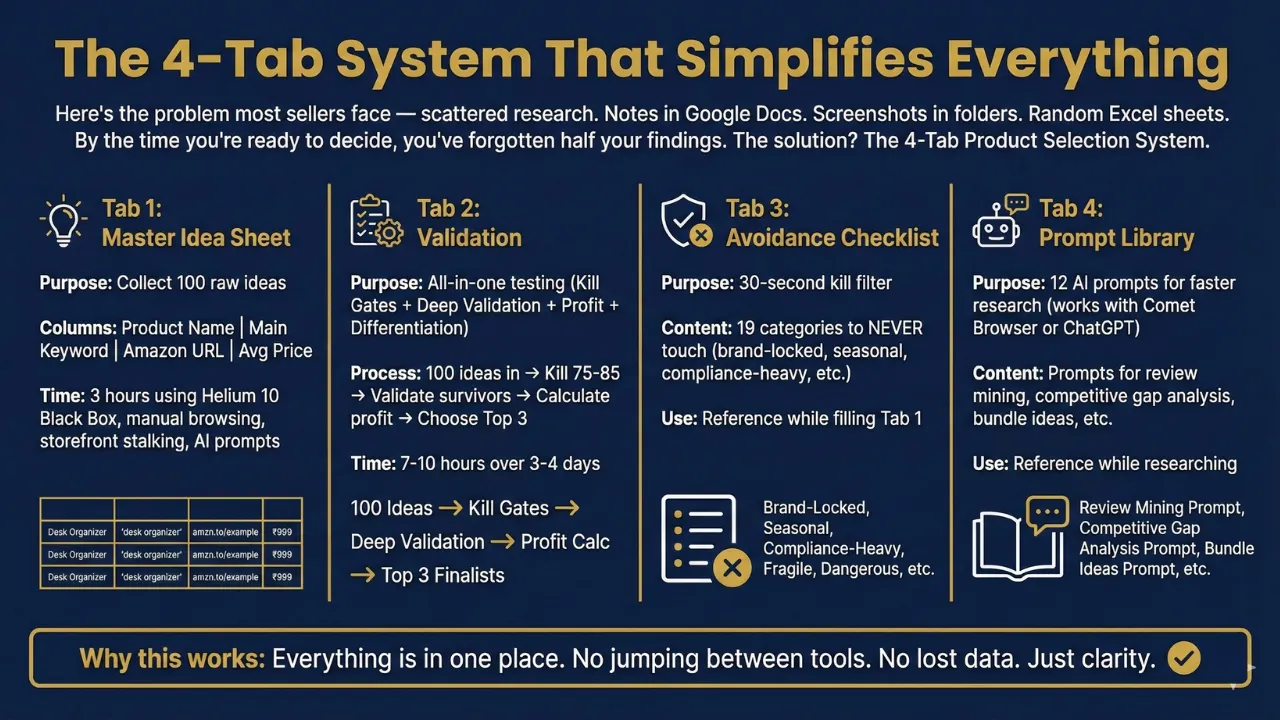
Here's the problem most sellers face — scattered research. Notes in Google Docs. Screenshots in folders. Random Excel sheets. By the time you're ready to decide, you've forgotten half your findings.
The solution? The 4-Tab Product Selection System.
Tab 1: Master Idea Sheet
Purpose: Collect 100 raw ideas
Columns: Product Name | Main Keyword | Amazon URL | Avg Price
Time: 3 hours using Helium 10 Black Box, manual browsing, storefront stalking, AI prompts
Tab 2: Validation
Purpose: All-in-one testing (Kill Gates + Deep Validation + Profit + Differentiation)
Process: 100 ideas in → Kill 75-85 → Validate survivors → Calculate profit → Choose Top 3
Time: 7-10 hours over 3-4 days
Tab 3: Avoidance Checklist
Purpose: 30-second kill filter
Content: 19 categories to NEVER touch (brand-locked, seasonal, compliance-heavy, etc.)
Use: Reference while filling Tab 1
Tab 4: Prompt Library
Purpose: 12 AI prompts for faster research (works with Comet Browser or ChatGPT)
Content: Prompts for review mining, competitive gap analysis, bundle ideas, etc.
Why this works: Everything is in one place. No jumping between tools. No lost data. Just clarity.
Want the complete 4-tab workbook? It's included in this Product Selection Training (Click Here To Access The Video).
How Helium 10 Powers Every Stage of Validation
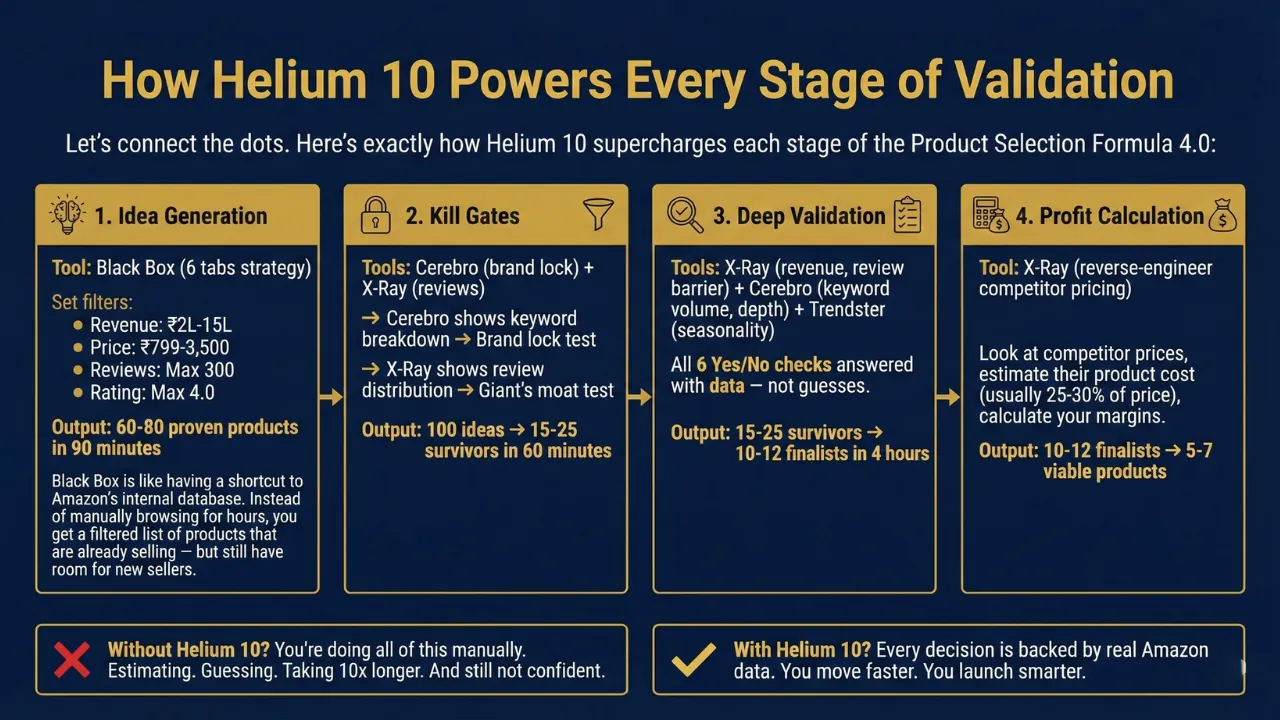
Let's connect the dots. Here's exactly how Helium 10 supercharges each stage of the Product Selection Formula 4.0:
Stage 1: Idea Generation
Tool: Black Box (6 tabs strategy)
Set filters:
- Revenue: ₹2L-15L
- Price: ₹799-3,500
- Reviews: Max 300
- Rating: Max 4.0
Output: 60-80 proven products in 90 minutes
Black Box is like having a shortcut to Amazon's internal database. Instead of manually browsing for hours, you get a filtered list of products that are already selling — but still have room for new sellers.
Stage 2: Kill Gates
Tools: Cerebro (brand lock) + X-Ray (reviews)
- Cerebro shows keyword breakdown → Brand lock test
- X-Ray shows review distribution → Giant's moat test
Output: 100 ideas → 15-25 survivors in 60 minutes
Stage 3: Deep Validation
Tools: X-Ray (revenue, review barrier) + Cerebro (keyword volume, depth) + Trendster (seasonality)
All 6 Yes/No checks answered with data — not guesses.
Output: 15-25 survivors → 10-12 finalists in 4 hours
Stage 4: Profit Calculation
Tool: X-Ray (reverse-engineer competitor pricing)
Look at competitor prices, estimate their product cost (usually 25-30% of price), calculate your margins.
Output: 10-12 finalists → 5-7 viable products
Without Helium 10?
You're doing all of this manually. Estimating. Guessing. Taking 10x longer. And still not confident.
With Helium 10?
Every decision is backed by real Amazon data. You move faster. You launch smarter.
Get Helium 10 at 40% off — currently $59/month.
Real Example: Validating a Product in 15 Minutes
Let's make this concrete. Here's how to validate “Bamboo Laptop Stand” using Helium 10 in 15 minutes.
Step 1: Kill Gates (5 minutes)
Gate 1 – Brand Lock (Cerebro):
- Paste top competitor ASIN
- Top keywords: “laptop stand,” “bamboo laptop stand,” “laptop riser”
- 0% branded keywords
- ✅ PASS
Gate 2 – Reviews (X-Ray):
- Run X-Ray on “laptop stand bamboo”
- Review counts: 850, 620, 480, 450, 380, 320, 280, 250
- Median: 400
- ✅ PASS (below 2,000)
Gate 3 – Compliance:
- No BIS/FSSAI required
- ✅ PASS
Gate 4 – Price:
- Average price: ₹1,250
- ✅ PASS (above ₹999)
Result: Passed all 4 gates → Move to Deep Validation
Step 2: Deep Validation (10 minutes)
Check 1 – Revenue Distribution (X-Ray):
- 6 sellers making >₹2L/month
- ✅ YES
Check 2 – Search Volume (Cerebro):
- Main keyword: “laptop stand bamboo” = 3,400 searches/month
- ✅ YES
Check 3 – Keyword Depth (Cerebro):
- Related keywords >1,000: “bamboo stand,” “wooden laptop stand,” “laptop riser bamboo,” “adjustable laptop stand,” “desk laptop stand,” “ergonomic stand,” “laptop cooling stand,” “monitor riser”
- Count: 8 keywords
- ✅ YES
Check 4 – Review Barrier (X-Ray):
- Sellers with <500 reviews making >₹2L: 3 sellers
- ✅ YES
Check 5 – Seasonality (Trendster):
- 12-month graph: Flat (rank stays 7,500-9,200 all year)
- ✅ YES
Check 6 – Variations:
- Top sellers: 1-2 variations (Natural, Dark bamboo)
- ✅ YES
Total YES count: 6/6
Decision: GOLDMINE → Launch immediately
Time spent: 15 minutes
Confidence level: 95%
This is what data-driven product selection looks like. No guessing. No “I think this will work.” Just evidence.
FAQs: Product Selection & Helium 10
Do I need Helium 10 to find profitable products?
No — but you'll take 10x longer and have lower confidence. You can manually browse Amazon, count reviews, estimate sales — but Helium 10 automates all of that with real data. It's the difference between walking and driving. Both get you there, but one is far faster and less exhausting.
How long does validation take with Helium 10?
Kill Gates: 60 minutes for 100 products
Deep Validation: 12-15 minutes per product
Total for 20 products: ~4-5 hours
Without Helium 10? Easily 15-20 hours.
What's the difference between Black Box and Cerebro?
Black Box = Product discovery tool. Finds products based on filters (revenue, price, reviews).
Cerebro = Keyword research tool. Shows which keywords a product ranks for and their search volumes.
Use Black Box to find products. Use Cerebro to validate them.
Is Helium 10 worth it for beginners?
Absolutely. The cost of launching one wrong product (₹2L loss) is 40x the annual cost of Helium 10. It's insurance against failure. Plus, the data you gather helps with pricing, keyword optimization, and competitive analysis — not just product selection.
Your Next Move: From Ideas to Launch-Ready Products
Every successful Amazon seller has a product graveyard — ideas that didn't work, launches that flopped, inventory that sat unsold. The difference between winners and quitters? Winners validated before they launched.
You now know the system:
- The 3 Pillars (AOV, Boring, Data)
- The 4 Kill Gates (60-minute filter)
- The 2-Pillar Deep Validation (6 Yes/No checks)
- The 4-Tab System (organized research)
- How Helium 10 powers it all
But knowing isn't enough. You need to implement.
Here's what to do next:
Step 1: Get access to the complete Product Selection Formula 4.0 system. I recently conducted a live training walking you through the entire process — live examples, real data, step-by-step walkthrough of the 4-tab workbook. You can access the replay instantly by clicking here and signing up.
Step 2: Get Helium 10. You can't validate products effectively without it. The current offer is $59/month (40% off). Grab it here.
Step 3: Start with 10 ideas. Don't aim for 100 on Day 1. Pick 10 products you're curious about. Run them through the Kill Gates. See what survives. Get comfortable with the tools.
Step 4: Join the training to see the full system in action — including how to use the 4-tab workbook, Helium 10 shortcuts, and AI-powered research hacks that cut your time in half.
Because here's the truth: Your ₹3-5L/month product is already out there. It's sitting in Amazon's search results right now — selling, converting, making someone else rich.
You just need the right lens to see it. And in 2026, that lens is Helium 10 + a proven validation system.
Stop guessing. Start validating.
Sign up for this Product Selection Formula 4.0 training here.
Let's find your winning product — together.
