

Why Most Amazon Sellers Lose Money on Their First Product
Picture this: You’ve found a product that excites you. Maybe a colleague recommended it. Maybe you saw it trending on Instagram. You spend three weeks talking to suppliers, designing packaging, and writing listing copy. You invest ₹2 lakhs in inventory, launch on Amazon, and wait for orders.
Two months later — 23 sales. Your inventory sits untouched while competitors with average listings somehow fly off the shelves. You’re bleeding ₹1,200/month in storage fees and your ad spend has returned exactly nothing.
This isn’t a horror story. This is Tuesday for most new Amazon sellers. They fail because they pick products based on gut feeling, not data. They see high search volume and assume “huge demand!” without checking if competition is brutal. They notice low review counts and assume “easy to enter!” without realising sales are dead.
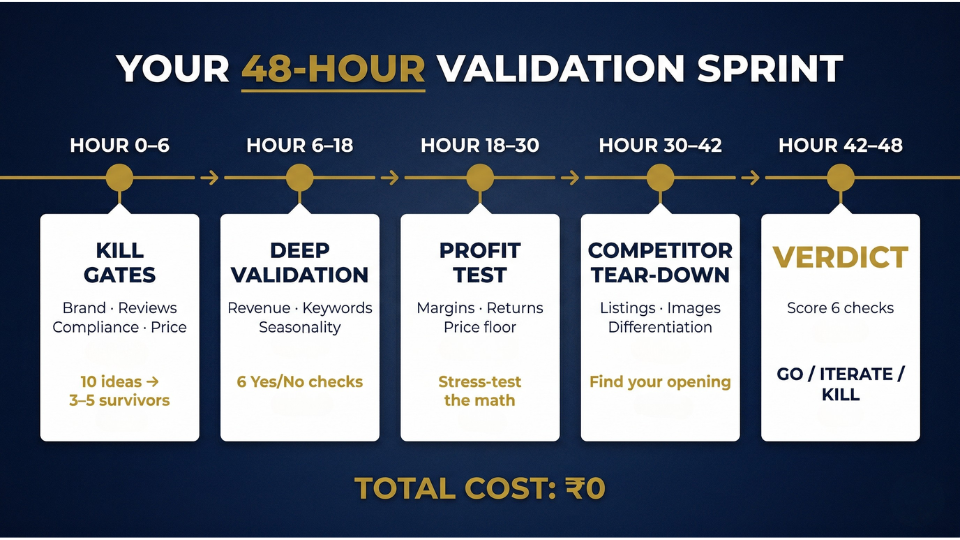
The fix isn’t better guessing — it’s a structured validation process. And here’s the part most people miss: you can run this entire process in 48 hours, over a single weekend, without spending a single rupee. All you need is Helium 10, Amazon search, and the framework in this post.

The 48-Hour Mindset: Why Speed Beats Perfection
The goal of these 48 hours is not to find the perfect product. It’s to kill bad ideas fast. Most sellers spend weeks emotionally attached to one idea — researching it, designing mockups, and by the time data says it won’t work, they’ve already invested time and money.
The 48-hour sprint flips this. You start with 10–15 ideas and run every one through brutal filters. By the end, 80% are dead. The survivors aren’t guaranteed winners — but they’re data-backed contenders worth investing in.
Priya Nair from Kochi tried this last February. She started Saturday morning with twelve ideas. By Sunday evening, she’d killed ten using Helium 10‘s free trial and Amazon search. The two survivors both passed every check. She launched the stronger one in April and crossed ₹1.8 lakhs monthly within ten weeks.
Hour 0–6: The 4 Kill Gates (Your Brutal Product Filter)
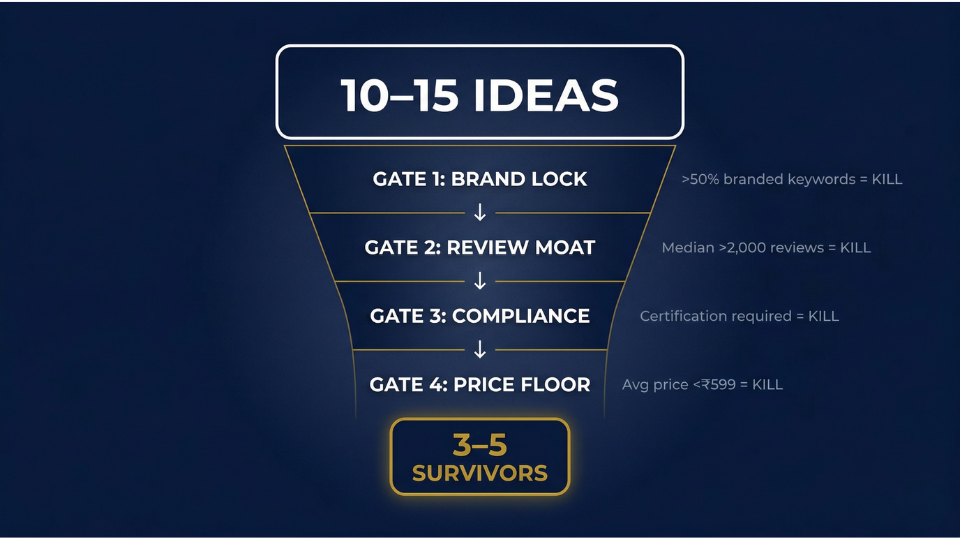
You’ve got 10–15 ideas. How do you eliminate the losers fast? Enter the 4 Kill Gates — a no-mercy filter that removes 75–85% of bad ideas before you waste time on deep research.
Gate 1: Brand Lock Test
If people search “JBL speaker” instead of “bluetooth speaker,” that market is brand-locked. You’ll never rank. Test it with Helium 10 Cerebro: copy a top competitor’s ASIN, paste it into Cerebro, and look at the top 10–20 keywords. Count how many include brand names — Nike, Sony, Boat, Prestige, Pigeon. More than 50% branded keywords means kill. Less than 50% means pass.
Gate 2: Giant’s Moat Test
If everyone on Page 1 has 2,000+ reviews, you’re entering a fortress. Test with Helium 10 X-Ray: search your main keyword, run X-Ray, check review counts for the top 10 sellers, and find the median. Median above 2,000 means kill. Below 2,000 — especially if sellers with under 500 reviews are making good revenue — means you can compete.
Gate 3: Compliance Hell Test
BIS, FSSAI, WPC, LMPC — these certifications cost ₹50,000 to ₹2 lakhs and take 2–6 months. Open the top 5 competitor listings and look for certification mentions. Electronics need BIS. Food contact items need FSSAI. Bluetooth products need WPC. If certification is required, kill it.
Gate 4: Margin Trap Test
Note the prices of the top 5 sellers and calculate the average. Below ₹599 is a kill — margins collapse after Amazon fees, shipping, ads, and returns. Between ₹599 and ₹899 is risky unless you can bundle. Above ₹999 is a pass. Our guide on deciding your product’s selling price on Amazon walks through the exact margin math.
After six hours, you started with 10–15 ideas. Now you have 3–5 survivors. That’s the power of Kill Gates — brutal efficiency.
Hour 6–18: Deep Validation With Helium 10
Passing the Kill Gates means a product could work. But will it actually make you ₹2–3 lakhs per month? That’s what deep validation answers. Two pillars, six yes-or-no checks, all powered by Helium 10.
Pillar 1: Market Demand
Check 1 — Revenue Distribution. Are 5+ sellers making over ₹2 lakhs/month? Run X-Ray on your main keyword and look at the Revenue column. Count sellers showing ₹2,00,000+ monthly. If 5 or more sellers hit that mark, it’s a healthy market with distributed demand. If fewer than 5, it’s either a monopoly or a dying niche. This is your first hard yes-or-no.
Check 2 — Main Keyword Volume. Does the main keyword have over 2,000 searches/month? Paste a competitor’s ASIN into Cerebro and check the search volume of the top keyword. Below 2,000 means you’re 100% ad-dependent with no organic cushion. For amazon product research India, this matters even more — niche volumes on Amazon.in run 40–60% lower than US equivalents.
Check 3 — Keyword Depth. Are there 5+ related keywords with over 1,000 searches? Scan the Cerebro keyword list for keywords above 1,000 monthly searches with relevance above 70. Look for variations — “bamboo stand,” “wooden laptop stand,” “laptop riser,” “adjustable laptop stand.” You want at least 5 so that if your main keyword drops, backup traffic keeps flowing.
Pillar 2: Competition Level
Check 4 — Review Barrier. Are 2+ sellers with under 500 reviews making over ₹2 lakhs/month? Look at the Revenue and Reviews columns together in X-Ray. Find sellers with under 500 reviews AND over ₹2L revenue. If you spot at least 2, newcomers can win here. This is the single most important check in the entire process — it proves you don’t need thousands of reviews to compete.
Check 5 — Seasonality. Is the product evergreen? Copy a competitor ASIN into Helium 10Trendster and look at the 12-month sales rank graph. Flat line means year-round demand. Sharp spike in 1–2 months means seasonal risk. Our article on strategies for selling seasonal products on Amazon covers the timing playbook if you spot seasonal patterns.
Check 6 — Variation Complexity. Does the product need 3 or fewer variations? Check the top 5 competitor listings for colour, size, and material options. Average of 3 or fewer means simple inventory. If competitors run 10 colours and 5 sizes, that’s 50 SKUs and ₹5 lakhs in stock. For product number one, simplicity wins.
Hour 18–30: The Profit Stress Test
A product can pass every demand and competition check but still lose you money. This block is about making sure the math works.
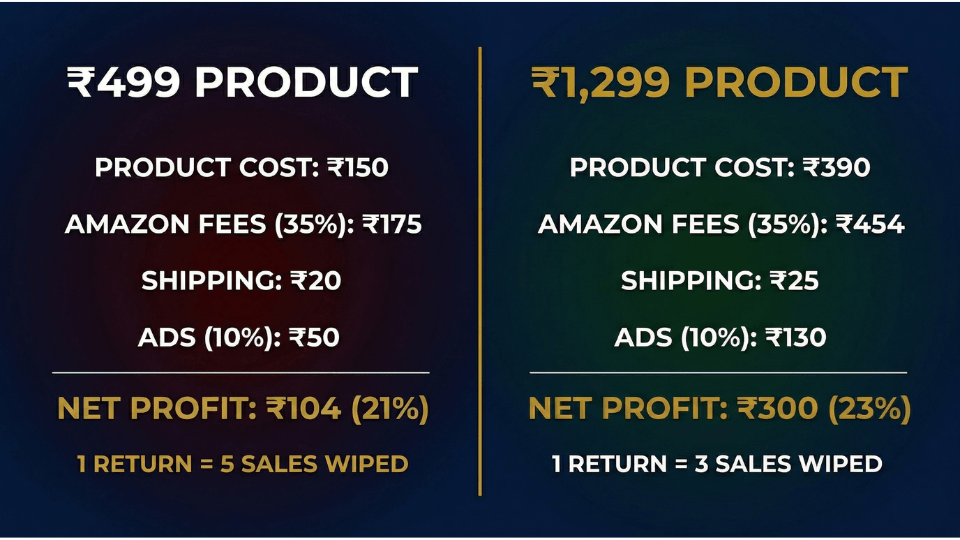
The ₹499 vs ₹1,299 Reality Check
Here’s what most sellers never calculate before ordering inventory. Take a ₹499 product: product cost ₹150, Amazon fees (35%) ₹175, shipping ₹20, ads (20%) ₹100. Net profit: ₹54, which is just 11%. One return wipes out 9 sales worth of profit. One competitor price drop kills your margin entirely.
Now take a ₹1,299 product: product cost ₹390, Amazon fees (35%) ₹454, shipping ₹25, ads (20%) ₹260. Net profit: ₹170, roughly 13%. Better margins. More breathing room. One return wipes out only 3 sales. This is why ₹999+ is the validation threshold — anything below it is a margin trap.
Rohan Mehta from Indore learned this the hard way. He launched a ₹399 phone stand with healthy sales volume but a 6% return rate. At ₹42 net margin per unit, every single return erased an entire day’s profit. He discontinued after three months and relaunched with a bundled desk organiser priced at ₹1,199. Same category, same audience, completely different business.
Hour 30–42: Competitor Tear-Down and Differentiation Check
Are the Top Sellers Actually Beatable?
Open the top 5 listings in your niche and study them as a buyer — not a seller. Are the images professional or do they look like phone photos with white backgrounds? Are the bullet points detailed and benefit-driven, or generic one-liners? Is there A+ Content? Arjun Reddy from Hyderabad found that three of the top five sellers in his target niche had blurry main images and single-line bullet points with zero A+ Content. That gap was his opportunity. He launched with professional lifestyle photography and detailed copy, and reached page one within six weeks.
If every top listing is polished, brand-registered, and loaded with premium imagery, the bar is much higher. Not impossible — but you need a genuine differentiator like a unique bundle, better materials, or a feature competitors are missing. Our guide on proven ways to differentiate your private label product covers exactly how to find that edge.
The “Can I Actually Win?” Gut Check
After tearing down competitors, ask three honest questions. Can I create a listing that’s visually better than page one? Can I offer something no current seller provides — a bundle, a feature, better quality? Do I understand this customer’s actual problem? If even one answer is a strong no, iterate or move to the next survivor.
Hour 42–48: The Final Verdict
Count Your Score
Go back to your six deep validation checks and count the total YES answers: revenue distribution, keyword volume, keyword depth, review barrier, seasonality, and variation complexity.
6 YES = Launch with confidence. This is a data-backed winner. Start contacting suppliers.
5 YES = Strong contender. Proceed, but stay sharp on the one weak area.
4 YES = Maybe. You need exceptional differentiation — better images, smarter bundle, superior quality — to overcome the gaps.
3 or fewer = Kill it. No shame. Move to the next idea.
The Validation Scorecard
Everything from these 48 hours should live on a single page — the check name, the Helium 10 tool you used, your pass-or-fail result, and a notes column for context. Print this scorecard. Pin it above your desk. Run every future product idea through it before you spend a single rupee on inventory, packaging, or supplier conversations. If you want the complete system with a ready-made workbook, our deep-dive on what makes a product an Amazon best seller shows how top sellers apply this framework consistently.
Real Example: Validating a Product in 48 Hours
Let’s make this concrete. Here’s how to validate “Bamboo Laptop Stand” using Helium 10 over a weekend.
Kill Gates (Hour 0–6):
Gate 1 — Brand Lock (Cerebro): Top keywords are “laptop stand,” “bamboo laptop stand,” “laptop riser.” Zero branded keywords. Pass.
Gate 2 — Reviews (X-Ray): Review counts for top 8 sellers: 850, 620, 480, 450, 380, 320, 280, 250. Median: 400. Pass.
Gate 3 — Compliance: No BIS, FSSAI, or WPC required. Pass.
Gate 4 — Price: Average selling price ₹1,250. Pass.
Deep Validation (Hour 6–18):
Check 1 — Revenue: 6 sellers making over ₹2L/month. Yes.
Check 2 — Search Volume: Main keyword “laptop stand bamboo” = 3,400 searches/month. Yes.
Check 3 — Keyword Depth: 8 related keywords above 1,000 searches — “bamboo stand,” “wooden laptop stand,” “laptop riser bamboo,” “adjustable laptop stand,” “desk laptop stand,” “ergonomic stand,” “laptop cooling stand,” “monitor riser.” Yes.
Check 4 — Review Barrier: 3 sellers with under 500 reviews making over ₹2L. Yes.
Check 5 — Seasonality (Trendster): Flat graph, rank stays between 7,500–9,200 all year. Yes.
Check 6 — Variations: Top sellers offer 1–2 variations (Natural, Dark bamboo). Yes.
Score: 6/6. Decision: Launch with confidence.
Time spent: one weekend. Money spent: zero. Confidence level: 95%. This is what data-driven product validation looks like.
FAQs: Amazon Product Validation
Can I validate an Amazon product for free?
You can manually browse Amazon and count reviews, but you’ll miss search volume and revenue data. Helium 10‘s free trial gives you the critical tools at zero cost. Manual research works — it’s just far slower and less accurate.
How long does Amazon product validation take?
Kill Gates take about 6 hours for 10–15 products. Deep Validation takes 2–3 hours per survivor. The full sprint fits into 48 hours over a weekend. Without tools, expect 15–20 hours with lower confidence.
What tools do I need to validate an Amazon product idea?
Helium 10 is the backbone, Cerebro for keywords, X-Ray for revenue and reviews, Trendster for seasonality. Add Amazon search for listing quality checks and a spreadsheet for your scorecard. That’s the complete toolkit.
How to check competition on Amazon India?
Run Helium 10 X-Ray on your main keyword. Check the top ten sellers’ review counts and monthly revenue. If revenue spreads across many sellers, especially some with under 500 reviews, the market has room for newcomers.
What is a good search volume for Amazon India keywords?
Main keyword: at least 2,000 monthly searches. Supporting keywords: at least five related terms above 1,000 each. This gives your listing multiple ranking paths and reduces the risk of depending on a single keyword.
Is Helium 10 worth it for beginners?
One wrong product launch costs ₹1.5 to ₹2.5 lakhs, many times a year’s Helium 10 subscription. The data helps with product selection, pricing, keyword optimisation, and competitive analysis. It pays for itself on the first validated product.
What if my product scores 4 out of 6?
Identify which checks failed. Fixable weaknesses like low keyword depth can be addressed with bundling or better listing strategy. Structural failures like brand dominance or seasonal demand can’t be fixed. Move on.
Can I validate products without Helium 10?
Yes, but you’ll miss search volumes, revenue estimates, and keyword depth. Manual validation takes roughly ten times longer with significantly less confidence. For serious sellers, the tool investment pays for itself quickly.
Your Next Move: From Idea to Launch-Ready in a Weekend
You now have the complete system: 4 Kill Gates, 6 deep validation checks, a profit stress test, and a competitor tear-down all packed into 48 hours, all costing zero rupees. The sellers who build ₹3–5 lakh/month businesses aren’t smarter than you. They just validate before they invest.
If you want to see this system in action live validation, real Helium 10 walkthroughs, and the complete workbook join our 3-Day Amazon Business Training.
Your winning product is already in Amazon’s search results. You just need 48 hours and the right lens to find it.
